The Aqua GUI in Apple’s operating systems has undergone a remarkable evolution since March of 2000, when it found its way into OS X 10.0, and you might be surprised at just how different everything looks now. Thanks to the newly launched Aqua Screenshot Library, you can revisit every version of OS X (and macOS) through the years and view the gradual evolution of Apple’s operating system—all from your browser.
The massive gallery is the latest work by 512 Pixels, an online library that attempts to keep tabs on all things Apple (including the Mac’s many wallpapers). The Aqua Screenshot Library, as creator Stephen Hackett notes, provides a comprehensive look at the history of Apple’s operating systems, which covers its jump to from bulkier CRTs to compact, LED-backlit displays; Apple’s various font changes over the years; and Apple’s move from disc-based operating systems to (free) digital downloads.
Let’s take a look at some of these major Mac milestones.
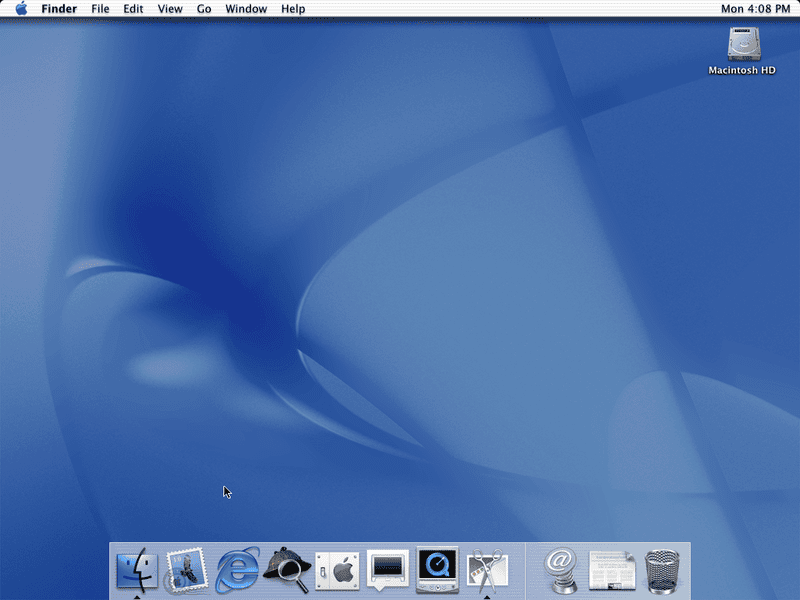
Mac OS X 10.0 (“Cheetah”)
Screenshot: 512 Pixels
March 24, 2001, marked the first official release of the Mac OS X operating system, following a public beta the year before. Hackett notes that its 128MB memory requirement was “more than most Mac users had in their systems at the time.” This lead to many complaints about the OS’s slow performance and high resource demand. The Cheetah interface retained the pin-striped menu and window design from the beta, but it began the feline-based naming trend which would last up to version 10.8, “Mountain Lion.”
Mac OS X Leopard (10.5)
Screenshot: 512 Pixels
The final months of 2007 brought some big changes to OS X. The release of Leopard saw Aqua take on a much more streamlined look, with all windows now defaulting to a single, simple grey design, as well as the debut of a redesigned Finder tool. Prior to this, different apps—and different versions of OS X—had varied UI designs (for better or worse). With Leopard’s release, OS X started to look more uniform. Most importantly, it was the first version to include those rad, space-based backgrounds.
OS X Mountain Lion (10.8)
Screenshot: 512 Pixels
Mountain Lion was the first version of OS X to arrive after Steve Jobs’ death, and it focused on aligning Mac computers with the late CEO’s other major contribution to the tech industry: the iPhone. The 2011 OS X update, Mac OS X Lion (10.7), kicked off Apple’s merging of iOS aesthetics into OS X, and the company doubled down with Mountain Lion. Tools and applications were renamed after iOS features, and Apple added some small visual and input changes to bridge the two operating systems even closer together—in style, at least.
OS X Mavericks (10.9)
Screenshot: 512 Pixels
Mavericks was a major business pivot for Apple, as it was the first version of the OS the company released for free, offered to users as an upgrade via the App Store in October 2013. Apple hasn’t gone back to paid operating systems since—thankfully. Mavericks was also the first version of OS X to use non-feline nomenclature. It also ditched the galactic background theme for California landscapes, which we can all agree was a major blunder. Right?
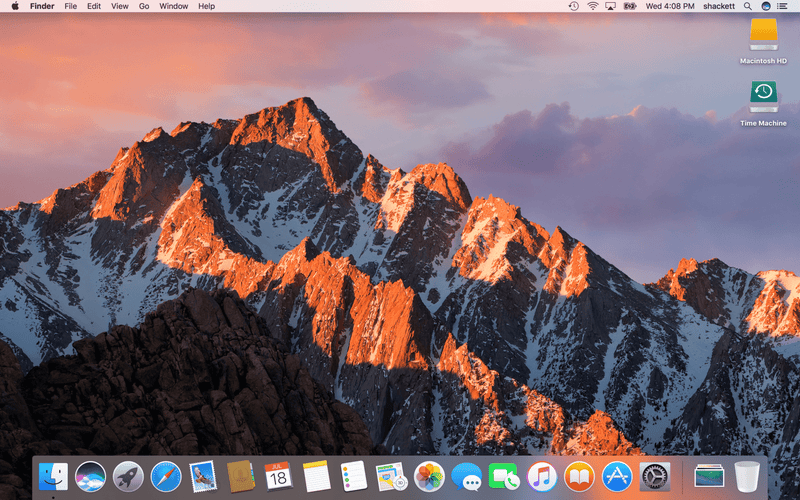
macOS Sierra (10.12)
Screenshot: 512 Pixels
Version 10.12 of Apple’s operating system for the Mac is most is notable for its big rebranding. Apple dropped the “OS X” name entirely in this release, instead calling its operating system “macOS” to align it the company’s operating systems on other platforms: iOS, watchOS, and tvOS. macOS Sierra also included a subtle, but noteworthy change of the operating system’s font from Myriad to Apple’s proprietary “San Francisco” typeface.
Advertisement
Browsing the Aqua Screenshot Library is a fun way to see just how far macOS has come, especially to see how Apple’s design priorities change between the major releases. However, the Aqua Screenshot gallery is just one of 512 Pixels’ many projects to check out. Be sure to poke around the other Apple-themed collections Hackett has assembled over the years, too, including the excellent 512 Pixels YouTube channel.
Shooting paper targets is a good way to practice your precision shooting..but for high-speed, run-and-gun dynamic shooting…nothing quite compares to a good steel target.
Personally, I love shooting steel more than anything else (well, maybe not as much as Tannerite, but that’s kind of expensive) and I have invested in quite a few steel targets for my home range.
Too much Tannerite…to learn all about how and when to use it, we got an article on that!
All of my steel targets are made out of AR500 steel, which allows them to take a beating and keep on keeping on. There really is nothing quite like them, and they provide a really nice shooting experience.
Provided you treat them right, they can last for hundreds of thousands of rounds and are great for self-defense training, competition training, and just plain fun.
Let’s talk about how these amazing targets work, what kind of targets you can get, and how to choose the best one for your purpose.
Table of Contents
Loading…
What the Heck is AR500 Steel?
In short, it’s really hard.
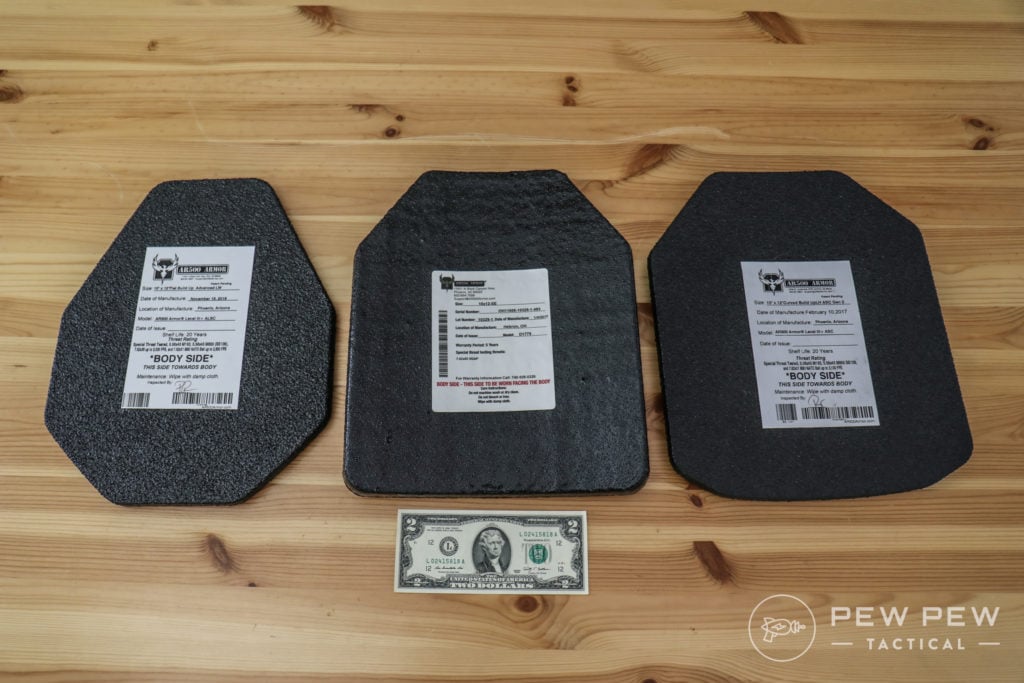
AR500 is the same steel that’s used in body armor like the stuff Eric tested a while back. The 500 part of the name denotes a certified Brinell hardness of 500.
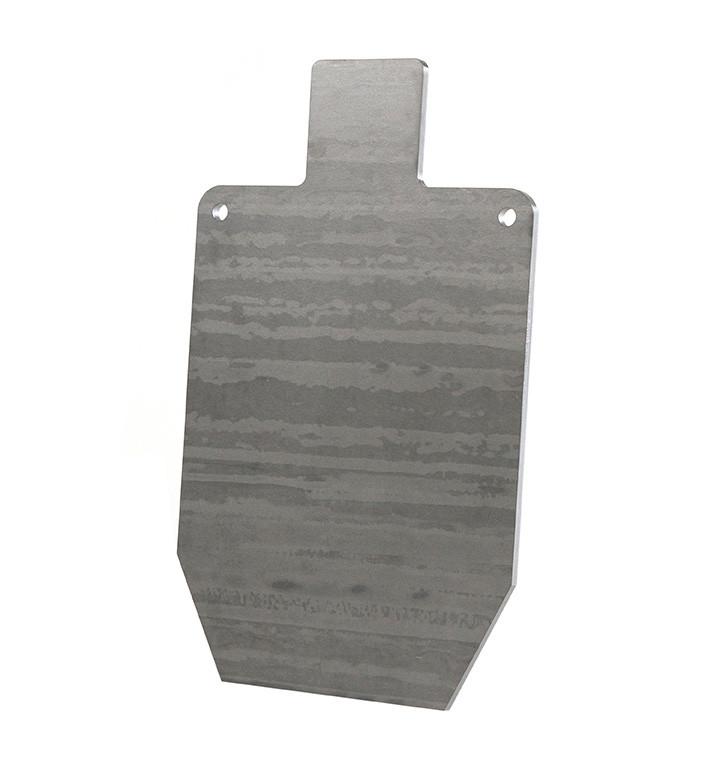
Different Cuts of Armor (L to R, Advanced LW Shooters Cut, SAPI, Advanced Shooters Cut Left)
Brinell testing is done by impact testing with a ball bearing to see if the steel chips or cracks, or Brinells which is a fancy way of saying “dents”.
In this case, we want the steel to dent because if it cracks, chips, flakes, or deforms in an inconsistent way, it can send ricochets and even whole bullets careening all over the place, including back towards the shooter instead of away.
In the industry, we call this a “no Bueno scenario”. For those of you that don’t speak French, that means bad.
As a rule, it’s best not to get shot, especially not with your own gun.
1,000 yard 9mm Shot…you don’t need to be THAT far away to use steel!
AR500 steel and other, similarly through-hardened steels prevent this by being strong enough to resist severe deformation under impact, and AR500 targets are surfaced in such a way as to make sure no pieces of copper or lead get sent back towards the firing line.
AR500 is also relatively easy to machine, so you get a wide variety of target options. This is also important because you don’t get a lot of heat introduced to the metal during the manufacturing process, which can ruin the temper (and thus the hardness) of the steel.
Using Steel Targets
Actually setting up and using steel targets seems fairly simple, but there are some things you need to do to protect yourself and your targets.
First, use properly hardened AR500 steel, from a reputable manufacturer. Unless it says AR500 or AR550 which is the harder version often used in rifle targets, stay away. Soft or mild steels will chip and deform, or just have a nice little hole put in them.
This is also why shooting at scrap metal like barrels, propane tanks, and old cars can be very dangerous, so do so at your own risk.
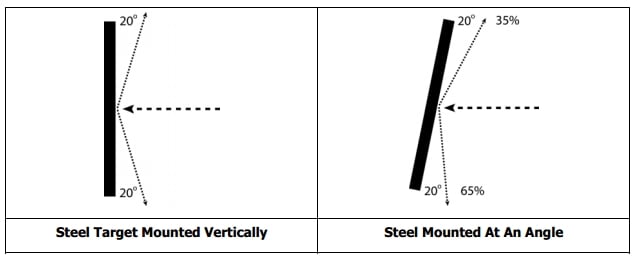
A proper AR500 or AR550 steel target, when hung at the proper angle and the correct distance for your caliber, and used with the correct bullet type, is perfectly safe.
Safe angles for steel, use them!
Stay away from steel-core rounds like M855 5.56, and avoid solid copper rounds. These rounds can seriously deform, or even penetrate steel targets. Stick to lead, copper-jacketed rounds, or even better, frangible munitions.
Frangible ammo is made of a pressed metal powder that explodes on impact with a hard target. They’re still very lethal, and sometimes recommended for home defense if over-penetration is a concern, but you can safely fire from point-blank range at a steel target and be just fine.
With all other bullet types, you should be at least ten yards away to be totally safe, and longer for rifle rounds. Your target should come with information regarding safe use with various calibers.
Speaking of, it’s important that you have a thick enough steel for the caliber you’re using, and the range you’re shooting at. You’ll want to calculate the energy of your round (velocity x bullet mass) and compare that to the manufacturers recommended minimum thickness and distance for your specific target.
Here are some general industry rules for AR500
0-700ft-lbs = ¼” AR500
700-2100ft-lbs = ⅜” AR500
2100-4000ft-lbs = ½” AR500
4000-10000ft-lbs = ⅝” AR500
Most of the time, AR550 is recommended for dynamic rifle targets, or any bullet that carries more than 2100ft-lbs of energy as a ½” or ⅝’ piece of AR500 is going to be extremely heavy and unwieldy.
If you’re looking for something to bang magnum rifle rounds off of, AR550, which can be thinner and therefore lighter than AR500, is probably a better idea, but if you’re just hanging the target and leaving it up, AR500 is fine.
And as far as hanging your targets, make sure you’re following the manufacturer’s recommended instructions for the appropriate angle and distance. I can’t stress enough how much you do not want to screw this up and have bullets flying back at you from the firing line.
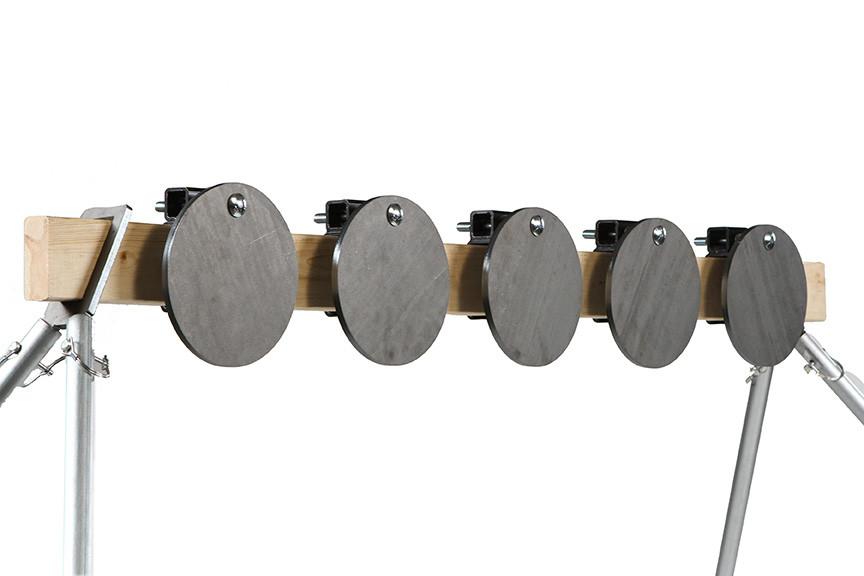
To aid in this, many manufacturers have special target stands that will ensure your target hangs safely and securely.
Finally, to care for your steel target in the long term, you’ll need to repaint it after every use so the exposed metal doesn’t rust. A simply rattle can of spray paint in your favorite color will do just fine, which is why I keep a can of white Rustoleum in my range bag.
Types of Steel Targets
There are two main categories of steel targets, static and dynamic.
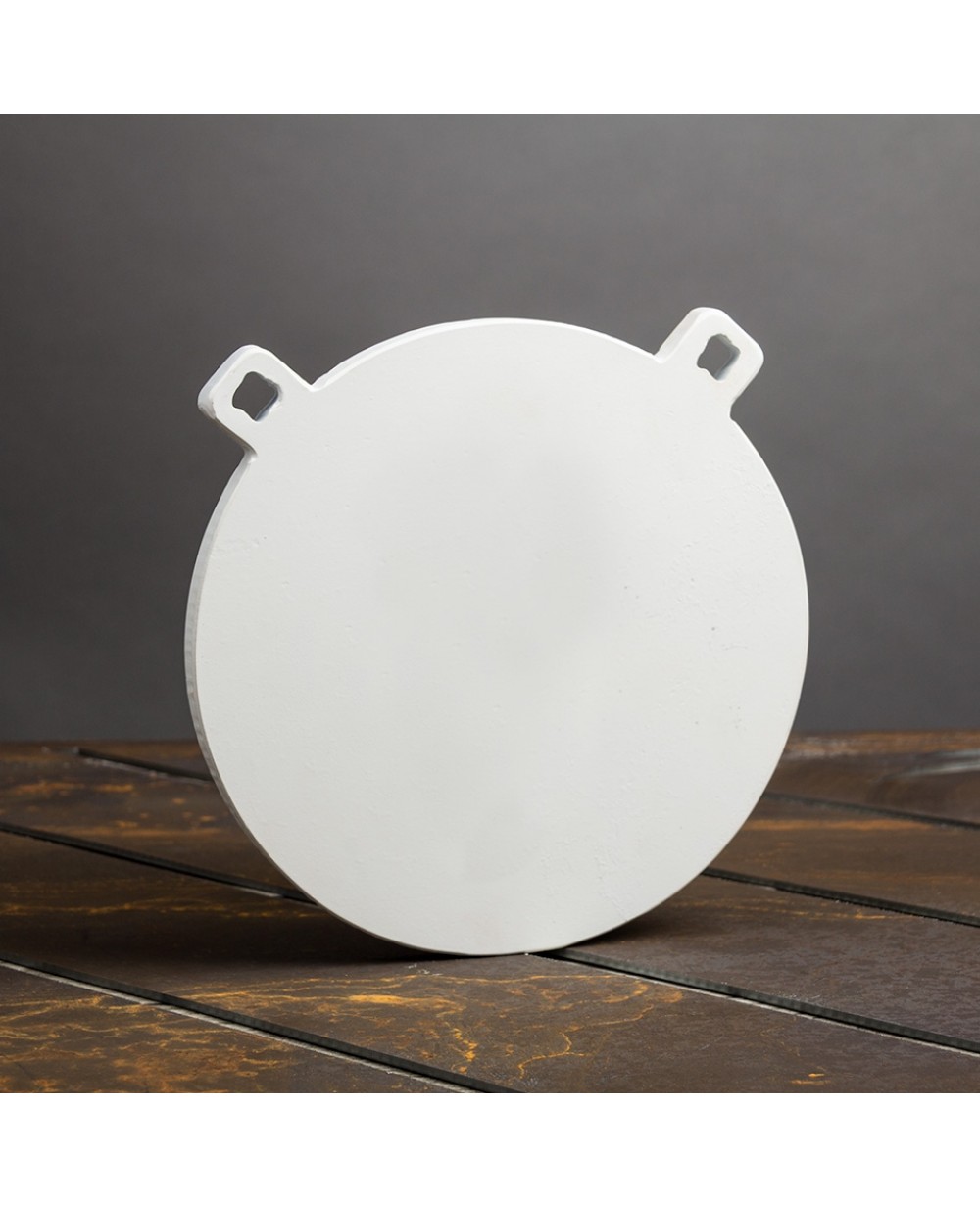
Static targets are things like silhouettes, gongs, things like that. They’re still more dynamic than paper because they give you nice audible feedback on a hit, but other than that they just chill there. Waiting to get shot. They’re awesome like that.
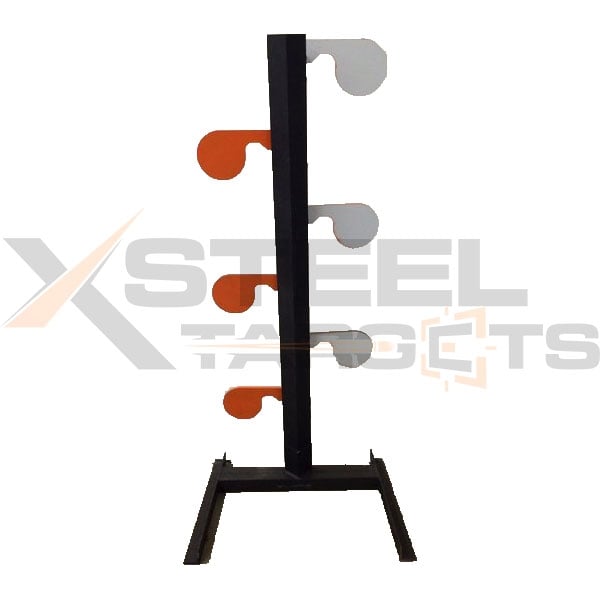
What’s even better though, at least in my opinion, are the dynamic targets. These are the things like falling Steel Challenge-style silhouettes that you can knock over, dueling trees where you can practice your speed shooting against yourself, or a buddy, and my least favorite target ever, this damn thing:
What we have here is basically a vertical seesaw or teeter-totter.
The goal is to shoot one end (I start with the bottom and I’m sure someone in the comments can tell me why that’s wrong) and then as the target swings back, shoot the other end swinging it back, and continue alternating until the target flips all the way around, like we all tried to do on the swingset as kids.
It’s a terribly frustrating, but incredibly rewarding target to shoot. And of course, the masochistic range officers out there just love putting them in 3Gun stages to make you burn a full minute and three pistol mags before giving up.
If you’re interested in learning how to get good at the spinner, take a look at this InRangeTV video! (some explicit language…it is a very frustrating target)
My personal favorites are the plate racks designed for pistol shooting. They give you all the fun of burning through a series of ceramic plates, without all the mess and expense. Just flip the targets back up, and either run them again or let someone else try and beat your time.
You can get six, eight, ten, and twelve-inch plates so you can accommodate any difficulty level or distance, and some models (the more expensive ones) will even automatically reset from a distance so you can shoot all day and never leave the firing line.
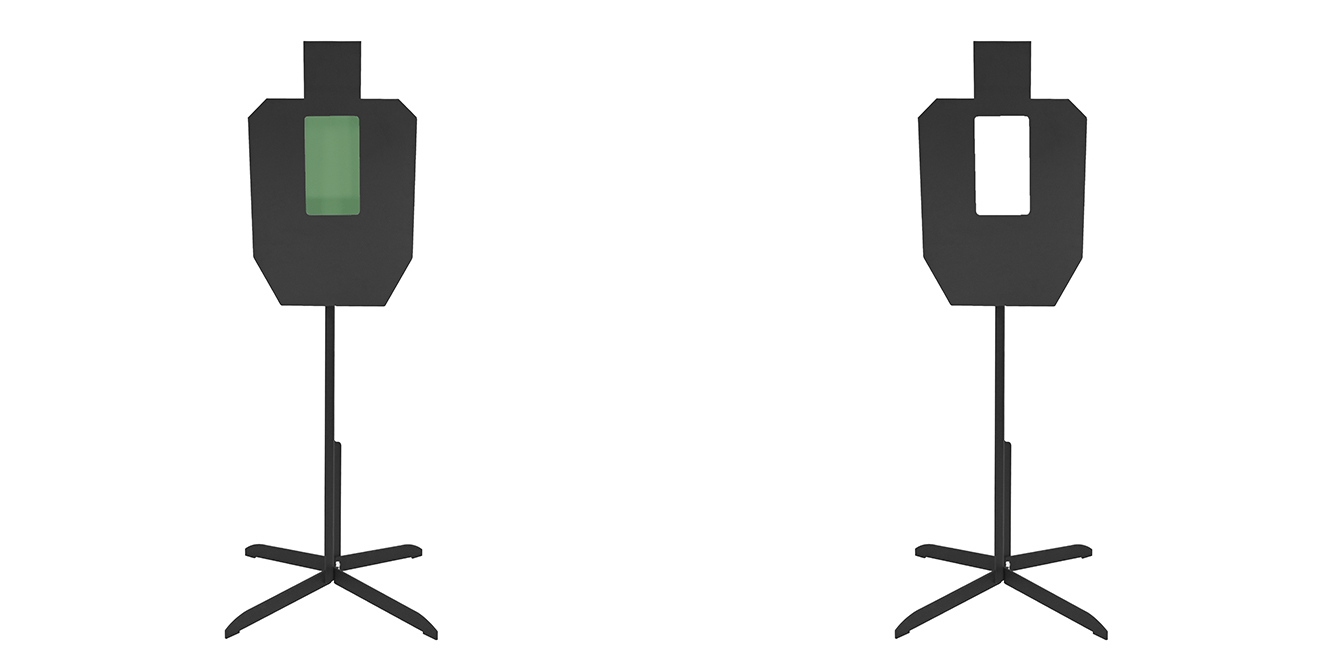
If you’re a little more practically minded, or just want to get better IDPA scores, you can pick up a whole slew of IDPA targets. This is essentially kill-zone targets that are perfect for defensive training, and are a pretty standard sight at most ranges.
The steel construction gives you less precision than when checking your hits on paper (I recommend repainting frequently to keep track of where your shots are landing if you’re getting one of these) but one steel target in this shape is going to be cheaper than three or four range trips worth of official IDPA paper targets, and will last half a million rounds if you take care of it.
You can use these targets with another of my personal favorites, the hostage swinger. This target presents a small target that swings back and forth to the left and right of the “head” of a no-shoot target. You can even get ones that attach to the back of an IDPA steel.
These swingers (no not those kind) work similarly to the spinner I mentioned earlier, but these simulate a dangerous hostage situation where you have to decide when to take the shot to get the bad guy represented by the swinging target, without hitting the hostage represented by the swinger.
Finally, you can get just about any kind of falling silhouettes, from pigs, goats, chickens and other farm animals, to game animal shapes like deer, turkeys, and bears, to zombies, unicorns, and vampires.
You can even get these types of targets custom cut so you can have pretty much anything you want, provided you have the money.
Best AR500 Steel Shooting Targets
There are sooooo many of these manufacturers out there, and it might seem like one would be as good as another.
I want you to imagine I’m speaking to you with the voice of a middle-aged NY businessman recently elected President when I say that you are, WRONG.
Cheap steel targets can be churned out by anyone with a sufficient laser cutter and some time to kill. Great steel targets, properly heat-treated and capable of lasting for hundreds of thousands if not millions of rounds, are harder to come by.
These are of course not the only steel target manufacturers worth buying from, and if I had space I’d list 5-10 more, but for some to get you started on your search, and to use as a comparison in price and quality, these are the five I recommend.
AR500 Armor is the folks that made the body armor Eric tested a while back, but they also make some bomb-ass (and bomb-proof) targets as well…all out of that awesome AR500 steel.
They offer a variety of targets, such as ISPC cutouts, A-zones, gongs, and more. They also have everything from stands, to medical equipment so they’re truly a one-stop shop for all your range needs.
Of course, they also have plate carriers and the armored plates to go in them, making them a good place for military, law enforcement, and (overly) prepared citizens to shop if they’re worried about getting shot at.
Speaking of AR500 armor and carriers – they are currently rolling out a new line of armor carriers, check them out!
Shoot Steel calls themselves the industry leaders in steel targets, and it’s hard to refute that claim. They make some of the best targets around and offer some of the most varied options of any manufacturer on this list.
They’ve got various thicknesses, various packages, various shapes, stands, hangers, stencils for customizing your target, paint for refinishing your target, cardboard inserts for your targets…you name it, if it has to do with AR500 steel targets, you can get it from them.
They even have targets rated for .50 BMG, which frankly is amazing.
One of many veteran-owned companies in this niche, Shooting Targets 7 is one of the best for defensively-minded shooters. They produce a variety of shoot and no-shoot targets, bullseye targets you can back with paper or cardboard for more precise feedback, IDPA-style silhouettes, and simple swinging gongs and knock over targets.
40 AR500 steel targets and stands for only…$5,274! Or if you’re not made of money, they have smaller packages also!
They also have a variety of simple and lightweight stands that can be quickly and easily set up almost anywhere, making them a good choice if you want to build a dynamic home range that’s easy to change around, or if you frequently travel to remote locations to shoot and want to be able to bring your own targets with you.
Xsteel is one of the best value for the money target makers in the business. Founded by a group of shooters who looked at the high prices and poor machining of many steel targets that were available and said: “Well, we can do better than that”.
Dueling Tree, great for improving your pistol split times!
And for many years, they’ve done just that. Xsteel is a family-owned affair and both Bud and Will Sanson are hunters and target shooters with a desire to provide their peers with affordable steel targets that are still very well machined and durable.
Action Target is one of the bigger manufacturers of targets, bullet stops, and other higher-end range necessities. If you’ve ever been to a nice indoor range, chances are you’ve used at least some of their products, whether it was a target retriever or their vent systems.
IPSC A-Zone Reactive Target
For the home user, they make a huge variety of high-quality portable targets, from lightweight rimfire targets to plate racks and dueling trees.
They also make my personal favorite steel target, or at least my most used, which is an IDPA steel silhouette with a reactive A-zone that gives you the precision of a paper target, with the convenience and satisfaction of steel targets.
Parting Shots
Steel targets are a fantastic way to up your training game and have more fun at the range. While they do represent a pretty sizeable up-front investment, they can last for decades and hundreds of thousands of rounds.
Armed with this knowledge, you should have no problem picking steel targets of your very own. Personally, I think steel targets are one of the best training tools out there, and they make for a hugely fun shooting experience for everyone.
What do you think of these steel targets? Which one do you want? Got any questions? Let me hear from you in the comments! For more guns & gear…check out Editor’s Picks.
On late Thursday, T-Mobile revealed that hackers stole some of the personal data of 2 million people in a new data breach. From a report: In a brief intrusion, hackers stole "some" customer data including names, email addresses, account numbers, and other billing information. The good news is that they did not get credit card numbers, social security numbers, or passwords, according to the company. In its announcement, T-Mobile said that its cybersecurity team detected an "unauthorized capture of some information" on Monday, Aug. 20. A company spokesperson told me that the breach affected "about" or "slightly less than" 3% of its 77 million customers.
Back in February we noted how Facebook had launched a new security tool the company promised would "help keep you and your data safe when you browse and share information on the web." The product was effectively just reconstituted version of the Onavo VPN the company acquired back in 2013. We also noted how some reports were quick to point out that instead of making Facebook users’ data more private and secure, Facebook used the VPN to track users around the internet — specifically what users were doing when they visited other platforms and services.
"Interviews with more than a dozen people familiar with Facebook’s use of Onavo data show in detail how the social-media giant employs it to measure what people do on their phones beyond Facebook’s own suite of apps. That information shapes Facebook’s product and acquisition strategy—furthering its already formidable competitive edge, the people said."
At the time, Facebook spokespeople attempted to claim that this was no big deal because "websites and apps have used market-research services for years," and that the data collected by its nosy VPN helped the company improve its products.
But that response ignored the obvious problem: that Facebook has been pitching a product it claimed "protected" people’s privacy but did the exact opposite. During a massive, global privacy scandal. With regulators and media outlets around the world contemplating vast new privacy guidelines that could massively impact Facebook’s entire data-hoovering business model.
That anybody at Facebook thought this was a good idea is pretty remarkable.
This week, Facebook was forced to pull the company’s "data security app" from the Apple Store after the company found that the service violated its data-collection policies:
"Earlier this month, Apple officials informed Facebook that the app violated new rules outlined in June designed to limit data collection by app developers, the person familiar with the situation said. Apple informed Facebook that Onavo also violated a part of its developer agreement that prevents apps from using data in ways that go beyond what is directly relevant to the app or to provide advertising, the person added."
Admittedly, Apple’s app store approval process is certainly its own type of terrible. But the report notes that Apple demanded that Facebook "voluntarily" remove the app, and Facebook complied. As such, iOS users can no longer download the app, and users that have already installed it will no longer receive updates for it. It is, however, still available over at the Google Play store, if giving Facebook even greater insight into your online activity is a prospect that excites you.
The whole kerfuffle only punctuated our repeated point that VPN’s aren’t some kind of mystical privacy panacea. In the wake of the GOP killing broadband privacy rules and the myriad other privacy and hacking scandals, countless people have been flocking to VPNs under the mistaken belief that a VPN is some kind of silver bullet. But a VPN is only as good as the people running it on the other end. And if the people on the other end are running scams or lying about what data is collected and stored (which is incredibly common in the VPN realm) you’re not a whole lot better off.
In short, who you get your VPN from is incredibly important, and if the person pitching you said VPN has a rich history of privacy abuses (be it Facebook or a giant, incumbent ISP like Verizon), you should probably know better than to trust the integrity of their promises, whatever form they take.
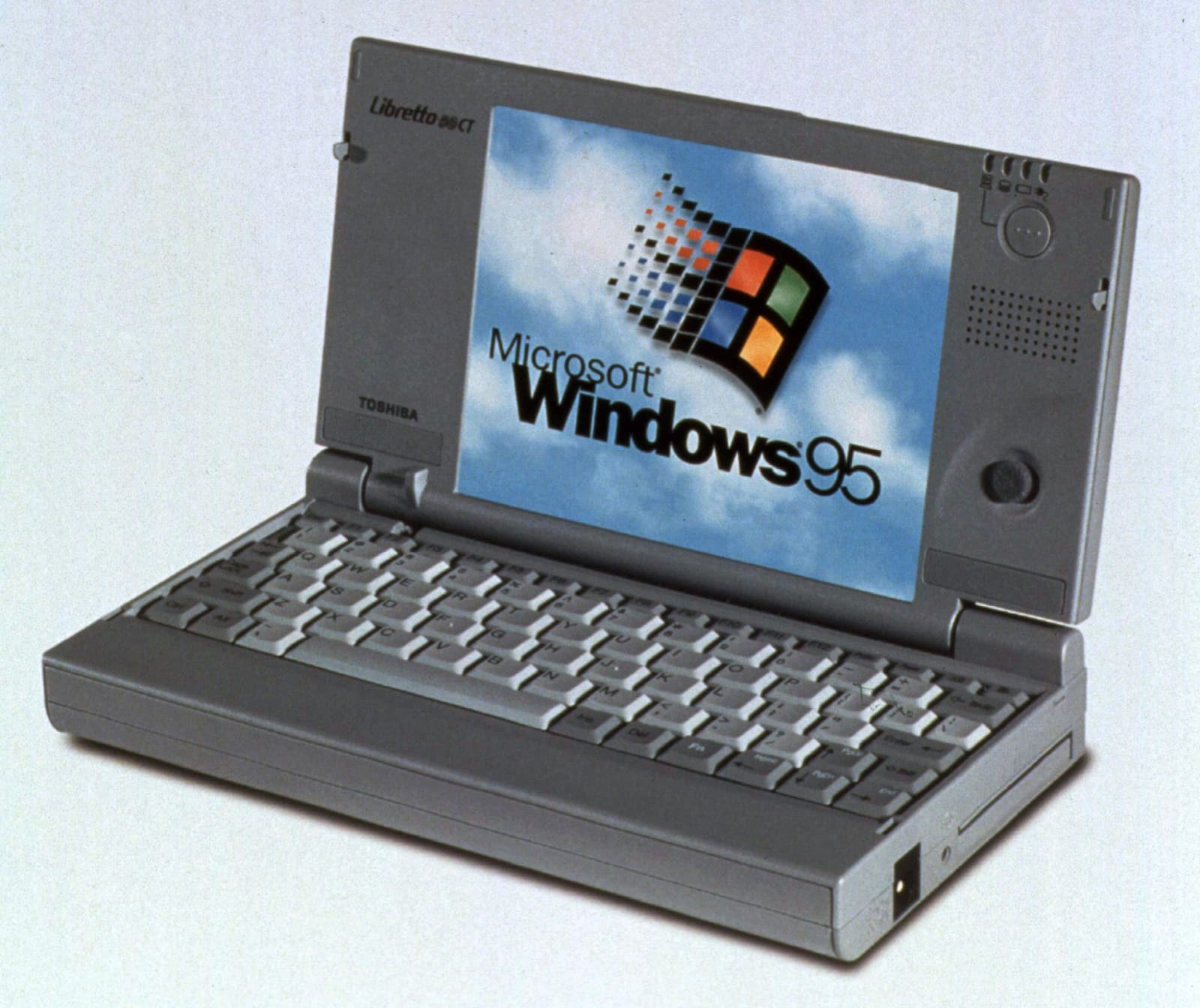
If you’re nostalgic about old tech and software, then get ready: Slack developer Felix Rieseberg has created an app that allows you to run Windows 95 on Windows, macOS and Linux (which is perhaps more practical than running it on an Apple Watch). If you’re interested in downloading it, you can grab it over at GitHub.
According to The Verge, you can easily run applications such as WordPad, MS Paint and Minesweeper within the app. Internet Explorer, sadly, doesn’t work. The good news is if you’re playing around and encounter problems, you can simply reset the instance and start over again.
If you’re worried about storage space or RAM, then fear not. The OS is just 129MB to download. Once you have it up and running, it will only take up about 200MB of RAM, even when you’re running multiple applications and utilities, as The Verge notes.
Protecting the data stored in your database may have been at the top of your priorities recently, especially with the changes that were introduced earlier this year with GDPR.
There are a number of ways to protect this data, which until not so long ago would have meant either using an encrypted filesystem (e.g. LUKS), or encrypting the data before it is stored in the database (e.g. AES_ENCRYPT or other abstraction within the application). A few years ago, the options started to change, as Alexander Rubin discussed in MySQL Data at Rest Encryption, and now MariaDB®, MySQL®, and Percona Server for MySQL all support encryption at-rest. However, the options that you have—and, indeed, the variable names—vary depending upon which database version you are using.
In this blog post we will take a look at what constitutes the maximum level of at-rest encryption that can be achieved with each of the latest major GA releases from each provider. To allow a fair comparison across the three, we will focus on the file-based key management; keyring_file plugin for MySQL and Percona Server for MySQL along with file_key_management plugin for MariaDB.
MariaDB 10.3
The MariaDB team take the credit for leading the way with at-rest encryption, as most of their features have been present since the 10.1 release (most notably the beta release of 10.1.3 in March 2015). Google donated the tablespace encryption, and eperi donated per-table encryption and key identifier support.
The current feature set for MariaDB 10.3 comprises of the following variables:
Using the following configuration would give you maximum at-rest encryption with MariaDB 10.3:
plugin_load_add = file_key_management
file_key_management_filename = /etc/mysql/keys.enc
file_key_management_filekey = FILE:/etc/mysql/.key
file_key_management_encryption_algorithm = aes_cbc
innodb_encrypt_log = ON
innodb_encrypt_tables = FORCE
Innodb_encrypt_threads = 4
encrypt_binlog = ON
encrypt_tmp_disk_tables = ON
encrypt_tmp_files = ON
aria_encrypt_tables = ON
This configuration would provide the following at-rest protection:
automatic and enforced InnoDB tablespace encryption
automatic encryption of existing tables that have not been marked with
ENCRYPTED=NO
4 parallel encryption threads
encryption of temporary files and tables
encryption of Aria tables
binary log encryption
an encrypted file that contains the main encryption key
You can read more about preparing the keys, as well as the other key management plugins in the Encryption Key Management docs.
There is an existing bug related to encrypt_tmp_files (MDEV-14884), which causes the use of
mysqld --help --verbose
to fail, which if you are using the official MariaDB Docker container for 10.3 will cause you to be unable to keep mysqld up and running. Messages similar to these would be visible in the Docker logs:
ERROR: mysqld failed while attempting to check config
command was: "mysqld --verbose --help --log-bin-index=/tmp/tmp.HDiERM4SPx"
2018-08-15 13:38:15 0 [Note] Plugin 'FEEDBACK' is disabled.
2018-08-15 13:38:15 0 [ERROR] Failed to enable encryption of temporary files
2018-08-15 13:38:15 0 [ERROR] Aborting
N.B. you should be aware of the limitations for the implementation, most notably log tables and files are not encrypted and may contain data along with any query text.
One of the key features supported by MariaDB that is not yet supported by the other providers is the automatic, parallel encryption of tables that will occur when simply enabling
innodb_encrypt_tables
. This avoids the need to mark the existing tables for encryption using
ENCRYPTED=YES
, although at the same time it also does not automatically add the comment and so you would not see this information. Instead, to check for encrypted InnoDB tables in MariaDB you should check
information_schema.INNODB_TABLESPACES_ENCRYPTION
, an example query being:
mysql> SELECT SUBSTRING_INDEX(name, '/', 1) AS db_name,
   ->   SUBSTRING_INDEX(name, '/', -1) AS db_table,
   ->   COALESCE(ENCRYPTION_SCHEME, 0) AS encrypted
   -> FROM information_schema.INNODB_SYS_TABLESPACES
   -> LEFT JOIN INNODB_TABLESPACES_ENCRYPTION USING(name);
+---------+----------------------+-----------+
| db_name | db_table             | encrypted |
+---------+----------------------+-----------+
| mysql   | innodb_table_stats   |      1    |
| mysql   | innodb_index_stats   |      0    |
| mysql   | transaction_registry |      0    |
| mysql   | gtid_slave_pos       |      0    |
+---------+----------------------+-----------+
As can be inferred from this query, the system tables in MariaDB 10.3 are still predominantly MyISAM and as such cannot be encrypted.
MySQL
Whilst the enterprise version of MySQL has support for a number of data at-rest encryption features as of 5.7, most of them are not available to the community edition. The latest major release of the community version sees the main feature set comprise of:
This configuration would provide the following at-rest protection:
optional InnoDB tablespace encryption
redo and undo log encryption
You would need to create new, or alter existing tables with the
ENCRYPTION=Y
option, which would then be visible by examining
information_schema.INNODB_TABLESPACES
, an example query being:
mysql> SELECT TABLE_SCHEMA AS db_name,
   ->    TABLE_NAME AS db_table,
   ->    CREATE_OPTIONS LIKE '%ENCRYPTION="Y"%' AS encrypted
   -> FROM information_schema.INNODB_TABLESPACES ts
   -> INNER JOIN information_schema.TABLES t ON t.TABLE_SCHEMA = SUBSTRING_INDEX(ts.name, '/', 1)
   ->                                        AND t.TABLE_NAME = SUBSTRING_INDEX(ts.name, '/', -1);
+---------+-----------------+-----------+
| db_name | db_table        | encrypted |
+---------+-----------------+-----------+
| sys     | sys_config      |     1     |
+---------+-----------------+-----------+
N.B. You are able to encrypt the tablespaces in 5.7, in which case you should use
information_schema.INNODB_SYS_TABLESPACES
as the internal system views on the data dictionary were renamed (InnoDB Changes).
Unfortunately, whilst all of the tables in the mysql schema use the InnoDB engine (except for the log tables), you cannot encrypt them and instead get the following error:
ERROR 3183 (HY000): This tablespace can't be encrypted.
Interestingly, you are led to believe that you can indeed encrypt the
Last, but not least we have Percona Server for MySQL, which, whilst not completely matching MariaDB for features, is getting very close. As we shall see shortly, it does in fact have some interesting differences to both MySQL and MariaDB.
The current feature set for 5.7, which does indeed exceed the features provided by MySQL 5.7 and for the most part 8.0, is as follows:
This configuration would provide the following at-rest protection:
automatic and enforced InnoDB tablespace encryption
encryption of temporary files and tables
binary log encryption
encryption when performing online DDL
There are some additional features that are due for release in the near future:
Encryption of the doublewrite buffer
Automatic key rotation
Undo log and redo log encryption
InnoDB system tablespace encryption
InnoDB tablespace and redo log scrubbing
Amazon KMS keyring plugin
Just like MySQL, encryption of any existing tables needs to be specified via
ENCRYPTION=Y
via an
ALTER
, however new tables are automatically encrypted. Another difference is that in order to check which tables are encrypted you can should the flag set against the tablespace in
information_schema.INNODB_SYS_TABLESPACES
, an example query being:
mysql> SELECT SUBSTRING_INDEX(name, '/', 1) AS db_name,
   ->    SUBSTRING_INDEX(name, '/', -1) AS db_table,
   ->    (flag & 8192) != 0 AS encrypted
   -> FROM information_schema.INNODB_SYS_TABLESPACES;
+---------+---------------------------+-----------+
| db_name | db_table                  | encrypted |
+---------+---------------------------+-----------+
| sys     | sys_config                |      1    |
| mysql   | engine_cost               |      1    |
| mysql   | help_category             |      1    |
| mysql   | help_keyword              |      1    |
| mysql   | help_relation             |      1    |
| mysql   | help_topic                |      1    |
| mysql   | innodb_index_stats        |      1    |
| mysql   | innodb_table_stats        |      1    |
| mysql   | plugin                    |      1    |
| mysql   | servers                   |      1    |
| mysql   | server_cost               |      1    |
| mysql   | slave_master_info         |      1    |
| mysql   | slave_relay_log_info      |      1    |
| mysql   | slave_worker_info         |      1    |
| mysql   | time_zone                 |      1    |
| mysql   | time_zone_leap_second     |      1    |
| mysql   | time_zone_name            |      1    |
| mysql   | time_zone_transition      |      1    |
| mysql   | time_zone_transition_type |      1    |
| mysql   | gtid_executed             |      0    |
+---------+---------------------------+-----------+
Here you will see something interesting! We are able to encrypt most of the system tables, including two that are of significance, as they can contain plain text passwords:
In addition to the above, Percona Server for MySQL also supports using the opensource HashiCorp Vault to host the keyring decryption information using the keyring_vault plugin; utilizing this setup (provided Vault is not on the same device as your mysql service, and is configured correctly) gains you an additional layer of security.
You may also be interested in my earlier blog post on using Vault with MySQL, showing you how to store your credentials in a central location and use them to access your database, including the setup and configuration of Vault with Let’s Encrypt certificates.
Summary
There are significant differences both in terms of features and indeed variable names, but all of them are able to provide encryption of the InnoDB tablespaces that will be containing your persistent, sensitive data. The temporary tablespaces, InnoDB logs and temporary files contain transient data, so whilst they should ideally be encrypted, only a small section of data would exist in them for a finite amount of time which is less of a risk, albeit a risk nonetheless.
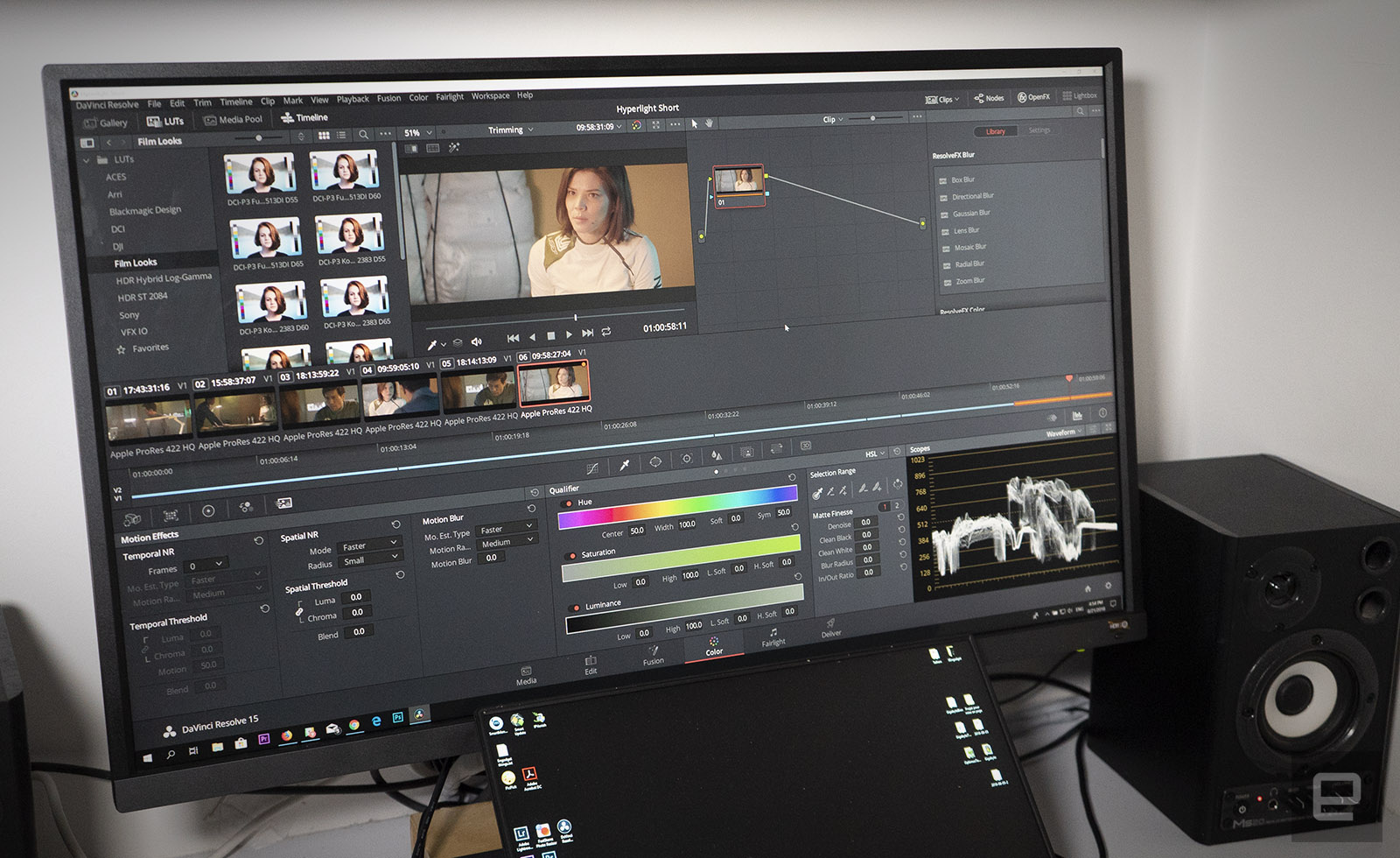
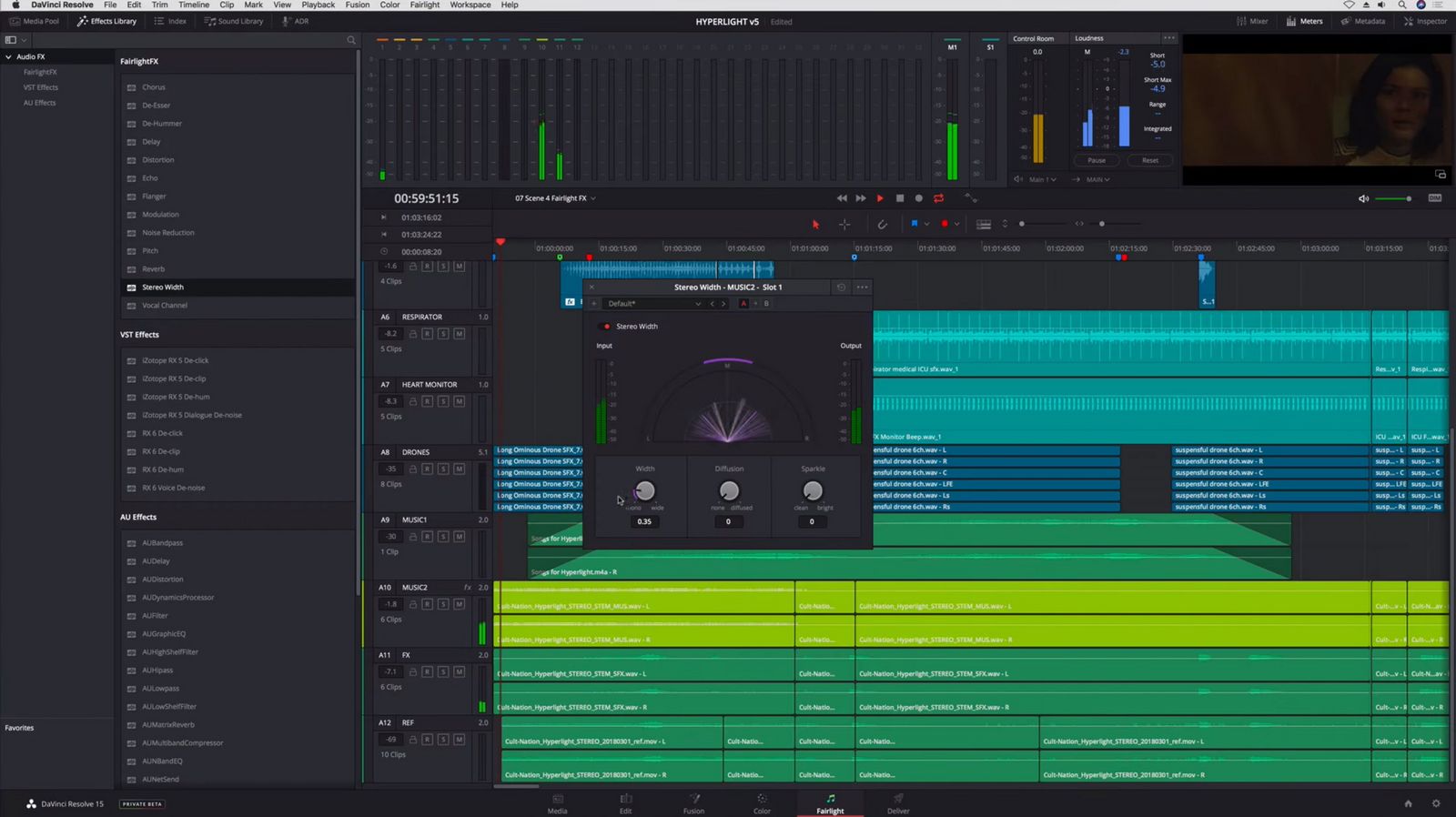
With the latest release of DaVinci Resolve 15, Blackmagic Design has radically made over its editing suite to create one of the best video-editing systems at any price — even against mainstream options like Premiere Pro CC and Apple’s Final Cut Pro X. It now comes with Fusion, a powerful visual effects (VFX) app used in Hollywood films, along with an excellent color corrector and audio editor. Despite doing more than most editors will ever need, the full studio release costs just $300, and you can get a stripped-down version with most features for a grand total of zero dollars.
I use Adobe’s Premiere Pro CC as part of its Creative Cloud suite, which costs more than $50 a month, so Resolve 15 is certainly a cheaper option. After trying it out for a week, would I be willing to switch? That would be tough, because I also do photo editing, and Creative Cloud includes Photoshop and Lightroom. If you’re looking strictly for video and audio editing, color correction and effects, however, Resolve is well worth a look. It is surprisingly easy to learn and use and has more speed and power than you’ll probably ever need.
New features
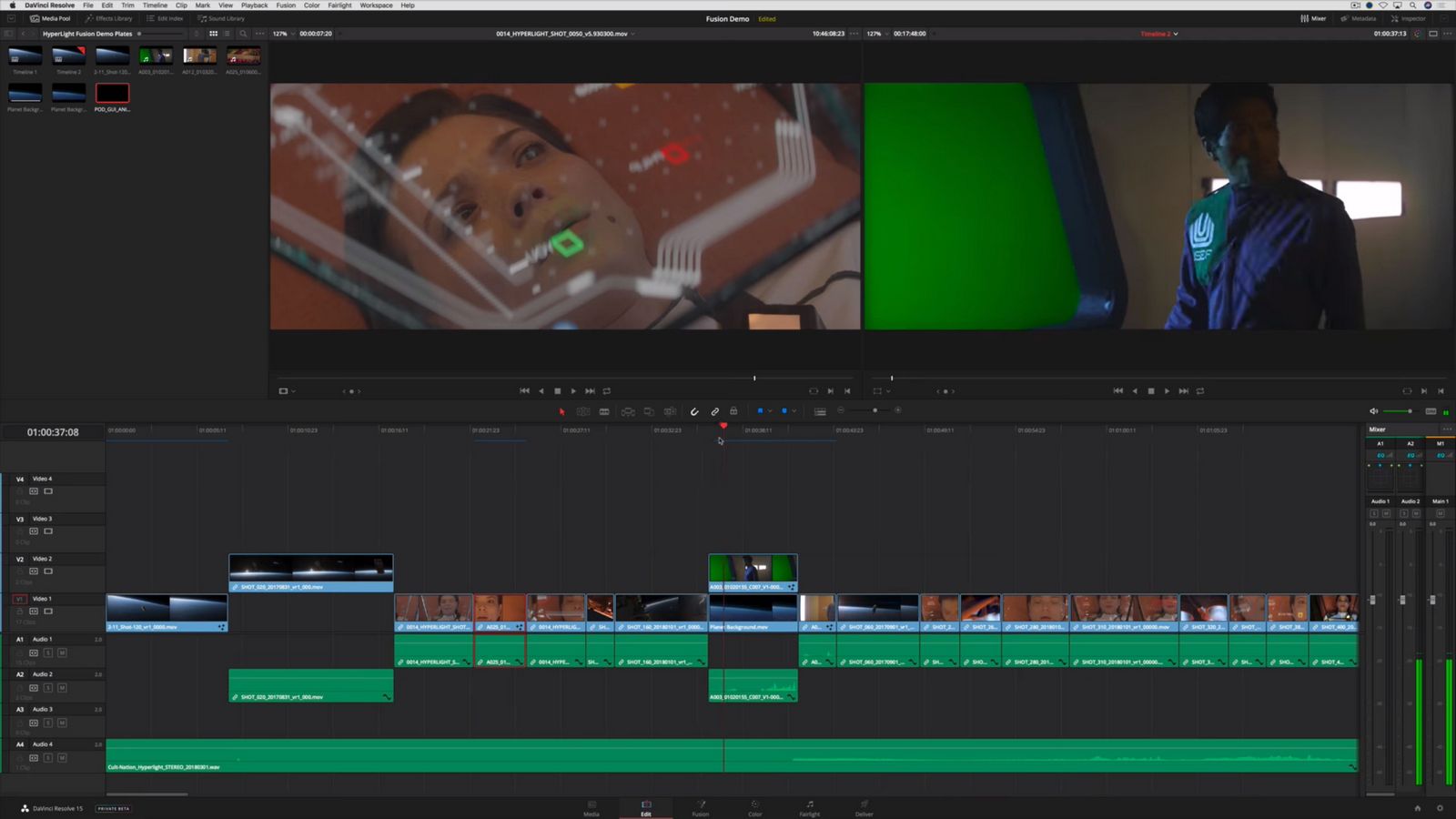
As before, DaVinci Resolve 15 is nearly platform agnostic, running on macOS, Windows 10 and Linux. However, it now has four modules (editing, color correction, audio effects and visual effects) all in one app. It was unveiled at the same time as Blackmagic’s Pocket Cinema Camera 4K (BMPCC 4K) and was designed to handle the extra-large and heavy files from that camera. As such, the editing module is not only much easier to use, but faster and more powerful.
Blackmagic improved the already excellent Color module, added more built-in effects, and tweaked the Fairlight audio editing app. It also supports a lot of new video formats, though some, like the MKV files used in YouTube videos, still don’t play.
The biggest change is the addition of Fusion, a Lego-like compositing app used in blockbusters like The Martian, Avengers: Age of Ultron and Kingsman: The Secret Service. Blackmagic sells Fusion as a standalone app (also for $300), so the integrated Resolve version isn’t quite as complete. But it has nearly all the same tools, including 3D compositing, particle effects, 3D text tools, keying, painting, rotoscoping and more. There are also a ton of additions in Color and the Fairlight audio package; for a complete list of features, check here.
Editing and Media
The first thing you’ll notice when opening a DaVinci Resolve 15 project is the sheer speed of the app. Blackmagic has dramatically improved performance for large projects, even if you’re working in 4K with thousands of clips, effects and timelines. That’s to the credit of the new video playback engine, which is better optimized to use both your CPU and your GPU (or multiple GPUs if you have the Studio version). The result is lower latency, faster UI refresh and rendering and better support for tricky formats like H.264 and RAW video.
Compared with Adobe’s latest version of Premiere Pro CC 2018, DaVinci Resolve 15 is faster in a couple of ways but slower in others. On my Windows 10 laptop with NVIDIA GeForce GTX 1070 Max-Q graphics and an 8th-gen Intel Core i7 CPU, Resolve loaded 4K H.264 clips from Panasonic’s GH5S camera much, much more quickly than its rival. However, when rendering a timeline with the same files, it was Premiere Pro that had the edge. Why so? Checking the task manager, it appears that Resolve is using the GPU better for playback, while Premiere taps it more during rendering.
The gold standard for media organization is Avid’s Media Composer, which is designed for large projects with thousands of clips that might be viewed and worked on by dozens of people at a time. Resolve isn’t as powerful, as it lacks screenplay integration and other advanced features. However, it’s pretty complete otherwise, and I found that I liked it better than Premiere CC for organizing, scaling and searching clips.
I also prefer Resolve 15’s cutting tools over Premiere Pro’s. It’s more intuitive for operations like trimming heads and tails of clips, slipping and sliding (moving a clip relative to other clips or changing its in and out point), unlinking clips and more. I also love the “dynamic” trimming that lets you adjust clips while playing them, and the latest version gives you better control over it. One thing I do miss on Premiere, however, is the “Track Select Forward” editing tool that lets you grab the lead clip to move an entire timeline.
Resolve now supports tabbed timelines like Premiere does. It also has a cool feature called “stacked timelines” that lets you position one edit on top of another and drag clips between them. This is particularly handy for editors who throw all their best material into one timeline, then drag the clips over to the final edit. Finally, the new “optical flow” is a great addition, as it calculates fake “tween” frames to smooth slow motion, even if you didn’t shoot at a high frame rate.
Color and audio
Before it was an editing app, DaVinci Resolve was a color correction tool, so it’s very powerful for that chore. Since it’s aimed at professionals, though, the color wheels, curves and bars aren’t very user friendly. Adobe’s color corrector is better for normals, because it looks more like Lightroom than something you’d see in a fancy post-production studio.
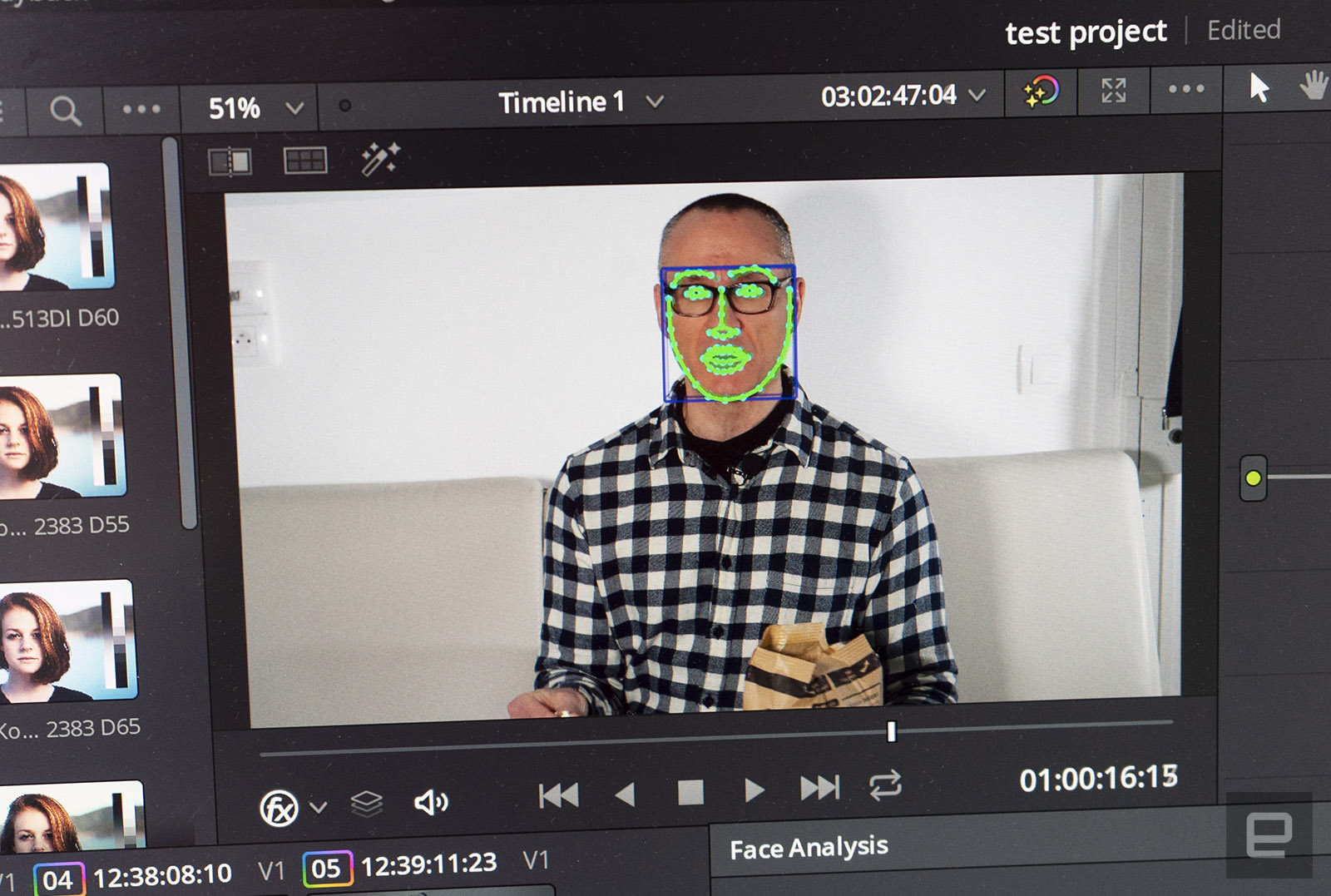
The power is there if you take the time to learn it, though. Much like Fusion, Color uses Lego-like “nodes” that let you layer together clips and color correction effects. You can also use “power windows,” complete with a motion tracker, to selectively adjust regions of an image. A good example is the “face refinement” feature that lets you track faces and then brighten your subject’s eyes, smooth their complexion and lighten or darken their face, without affecting the rest of the shot.
Resolve 15 also uses so-called look-up tables (LUTs) to create custom looks or instantly adjust footage from Sony, RED, Panasonic, Blackmagic and other video-centric cameras. The new version makes it a lot easier to browse through those to find just the right look. You can also more easily grab color settings from previous timelines and projects. Finally, the already good noise reduction system has been improved, and Resolve now supports Dolby Vision (for a price) and HDR 10+, the latest HDR system from Samsung and others.
A lot of editors don’t like dealing with audio, but here again, DaVinci Resolve 15 treats users a bit better than Premiere Pro does. Everyday tools like audio dissolves and fades are a bit easier to find, for one thing. And when you need to do advanced sweetening, jumping into the dedicated Fairlight audio editor is more seamless than switching to Audition CC, which is a completely separate app from Premiere.
Fairlight improvements include new ADR (aka automated dialogue replacement) tools, a “normalize audio level” function to make it easier to set levels and change the pitch of clips, and numerous refinements of the UI, controls and commands for playback and editing. On the Fairlight FX side, there are 13 new audio effects available both in Edit and Fairlight, including plugins for repairing audio, adding effects and simulating concert halls and other spaces.
Fusion
Fusion is one heck of a powerful VFX package. It lets you work in a full 3D space (with cameras, lighting and shaders) and do particle effects, warping, keying, color correction, painting and a whole lot more. Now that it’s embedded in DaVinci Resolve, you can work with multiple clips directly from the Edit timeline and quickly see them in context with the rest of your program.
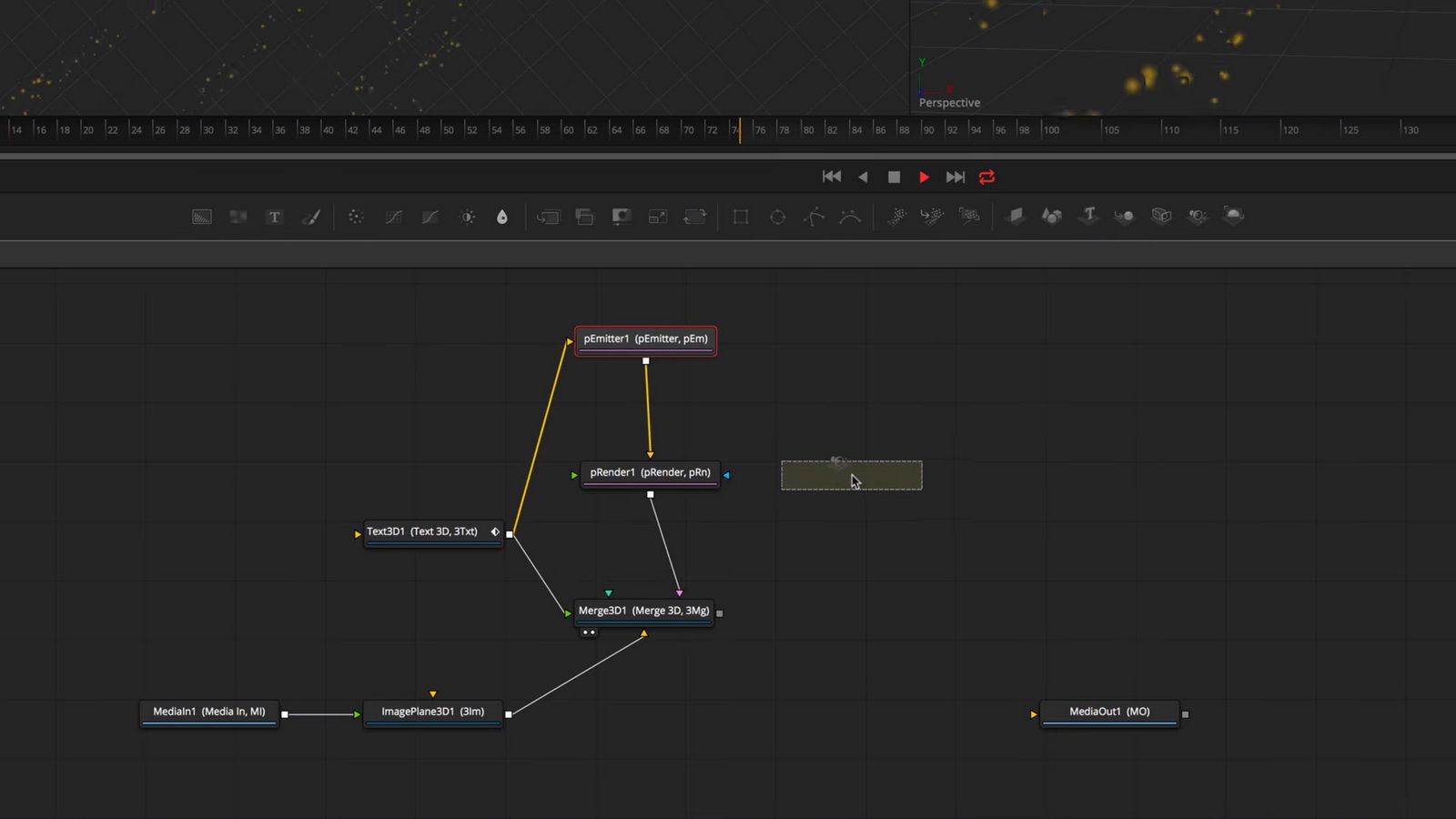
Such power comes with an equally breathtaking learning curve, however. The good news is that using Fusion is pretty fun, and Blackmagic provides tutorials and resources to help you grok it. Much like other compositing programs, including Autodesk’s Flame, Nuke and the (defunct) Apple program Shake, Fusion is a node-based VFX package that lets you layer multiple effects and clips by linking them together like Legos.
To use Fusion in DaVinci Resolve 15, you simply park the playhead (the line showing the current frame) over the clip or clips you want to affect and click the Fusion button. They then appear as nodes, and you’re ready to create some effects. For instance, you might have one node as a foreground green-screen shot, one as a background and another for text. You can then apply a chroma key, color corrector, warper, particles or whatever else you want to do, and output the whole thing to an output node. When you go back to Edit, you’ll see the (hopefully) glorious final result. If it’s not all that you hoped for, you can go back and tweak.
Fusion has 2D and 3D text tools with macros that let you do advanced motion graphics and particles that can interact with other 3D objects, along with masking, tracking, match-moving, rotoscoping and warping tools.
As mentioned, Fusion was originally designed to do special effects for big-budget films, so you might say that it’s heavy overkill for the average user. But if you don’t need all that power, most of the basics (transitions, scaling and moving, stabilization, color correction etc.) are available in the Edit or Color modules. So there’s no need to dip into Fusion until you’re ready.
If you pay for DaVinci Resolve 15 Studio, you do get a few things not available in the free version. That includes support for multiple GPUs, advanced noise reduction, the face tracker, a number of effects and filters, and support for 3D and VR. Finally, Studio offers easy multi-user collaboration and unlimited network rendering.
Wrap-up
Blackmagic Design has always been an interesting company, selling products like the RAW-video-capable Pocket Cinema Camera 4K at prices far below rivals like RED. Even at $300, DaVinci Resolve 15 seems underpriced. It’s stout enough to work with 8K RAW video files from RED and ARRI cameras that cost $50,000 and up. You can even connect one of Blackmagic’s crazy control surface consoles if you’re working with picky clients.
The redesigned Edit module is more powerful than ever and, to my surprise, pretty easy to grasp. I find that I now prefer using it for media organization and cutting over Premiere Pro CC. It’s also faster than its rival Premiere Pro CC in many ways.
All that said, it’s not for everyone. Adobe’s software still does certain things better, like warp video stabilization (it has many more controls), and I found that it rendered complex timelines quicker. Adobe is also on the cutting edge with its AI-powered Sensei tools, which help regular users color-match and automatically reduce (“duck”) music during dialogue.
It also has tight integration with apps like After Effects (Adobe’s rival Fusion product) and especially Photoshop. Many one-man-band video editors who also do photography might not want to learn a new product when they’re already paying for Photoshop and Lightroom anyway.
But if you’re just into video editing, give the free version of DaVinci Resolve 15 a whirl. If you like it and find you need the extra features in the paid version, you can step up to Studio for not a lot of cash. You’ll never be tied to a monthly plan, and you get all the subsequent versions for free. Things that seem too good to be true usually aren’t, but Resolve 15 is an exception to that rule — it’s a truly elegant and powerful editor that costs nearly nothing.
Between promotions, newsletters, notifications, and everything else that comes flying into your inbox every day, it’s very easy to accumulate too many emails. If you don’t have time to deal with it, you could find yourself sitting on an inbox with upwards of 20 to 30 thousand messages.
Somewhere in there, you’ve got important messages you don’t want to lose. But how do you empty out the clutter without tossing out the baby with the bathwater?
If you follow the process outlined in this article, you can get yourself down to inbox zero in at least 30 minutes. At the most, one hour. Want to give it a try? Open up your bloated inbox, and follow along.
The Bloated Gmail Inbox
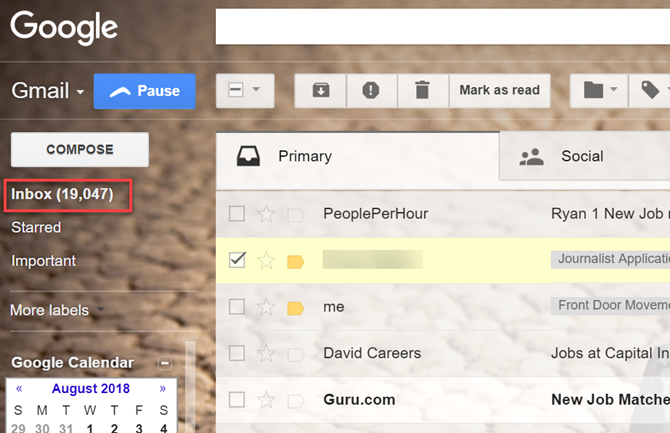
Introducing, the inbox of a very busy person.
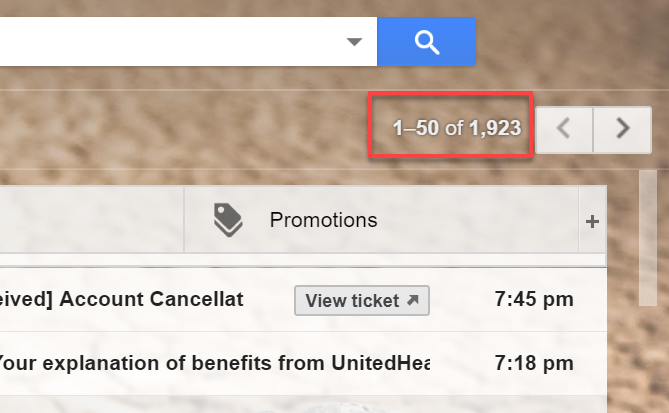
That’s right. Almost 20,000 unread email messages. Those are only the unread ones. The total size of my email account before starting this process was pushing 35,000 messages.
So, the first thing to do is chop off the low hanging fruit.
Toss Out the Trash
It should go without saying that you need to take out the trash often, not only at home but in your Gmail inbox as well.
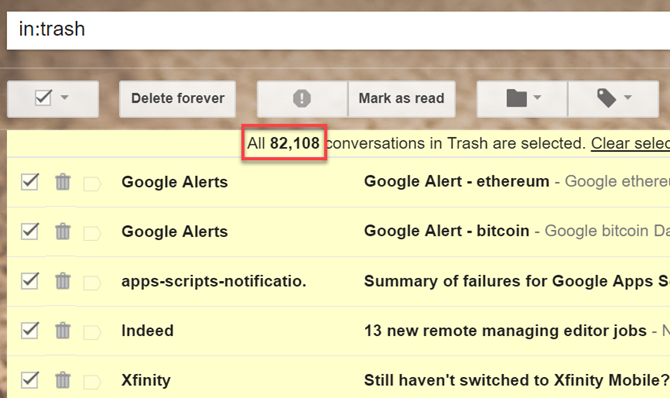
Click on your Trash in the left navigation bar, click the “select all” box at the top of the message list, and then click on the “All conversations” link listed before the first email.
How to Stop Spam Emails in Gmail Do you get too many emails? These clever Google Mail tips will help you stop unwanted spam emails before they clog up your Gmail inbox. Read More
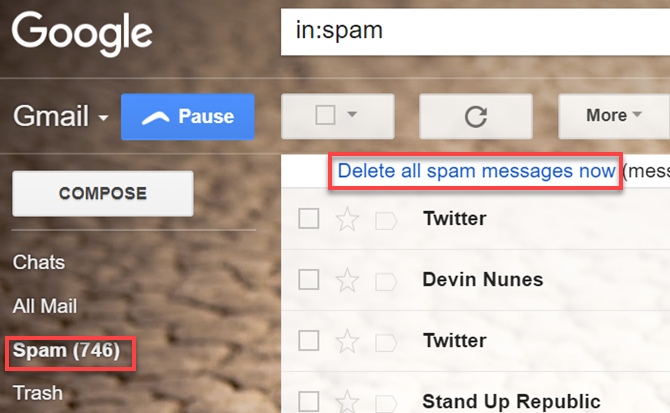
. In the navigation field, click on the Spam link, and then click on “Delete all spam messages now”.
Feels good, right? We haven’t really put a dent in the inbox yet, but it’s a great feeling to start cleaning your inbox after you’ve taken out the trash.
Now for the next level of low hanging fruit.
Social and Promotions
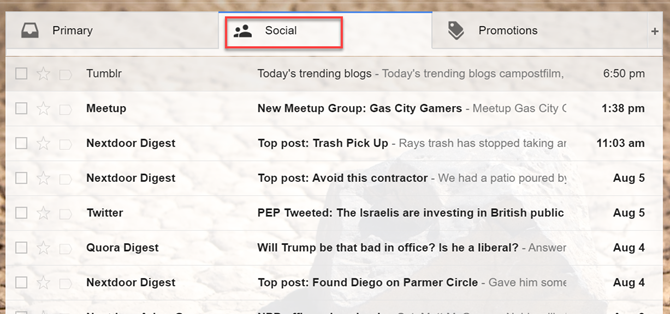
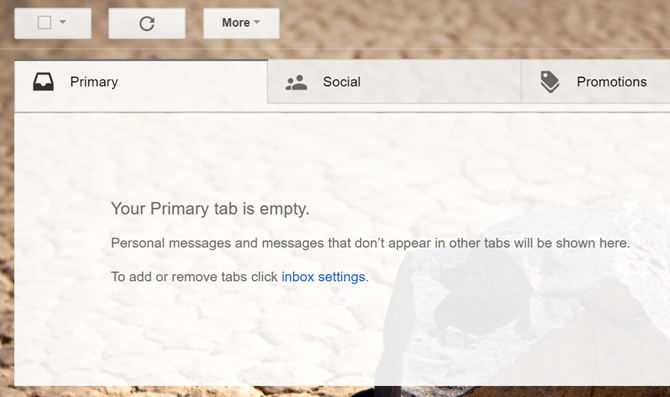
If you’re using Google’s default style Gmail inbox, then you’ll see Social and Promotion tabs at the top of your inbox.
Click on each of these and scroll down through the list looking for large volumes of duplicates.
These are the culprits that are filling up your inbox every day.
When you find them, open the email and find the Unsubscribe link near the top or bottom of the email.
How to Master Gmail Inbox Anxiety So many emails, so little time. Do you feel this way when it comes to managing your Gmail inbox? We show you simple settings and helpful tools to organize and stress-proof your Gmail inbox. Read More
to prevent yourself from getting into this mess all over again.
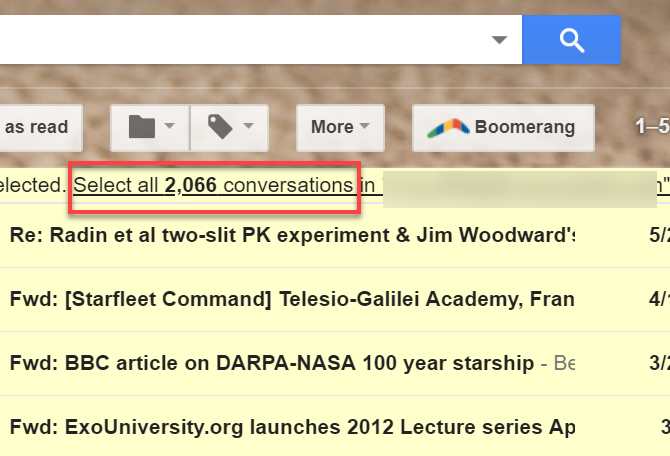
Once you’ve unsubscribed from the most common emails, click on the Select All icon at the top again, and click on the “Select all conversations” link at the top.
Click the trash icon to delete them all.
Repeat the same process on the Promotions tab. By the time you’re done deleting all of these, you’ve likely already chopped your inbox down by a few thousand.
The address closed in 2015 but I never bothered deleting all of those emails.
You’ve likely created all sorts of labels years ago. Maybe you even automated the process with filters for incoming emails. All of those emails are just sitting there wasting space.
You can’t just delete labeled emails in bulk, because you labeled them for a reason. Maybe they contain years of research, or they’re a historical archive of some work you did that you just don’t want to lose.
Back Up Important Labeled Emails
Luckily, it’s very easy to back up all those emails in bulk using Google’s account export feature.
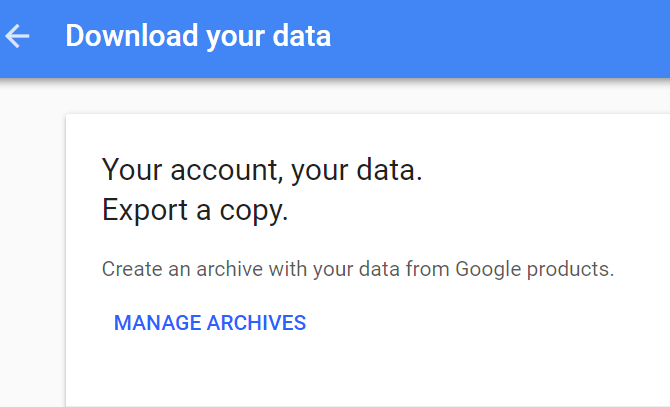
Google offers a Download Your Data page for every service in your Google account.
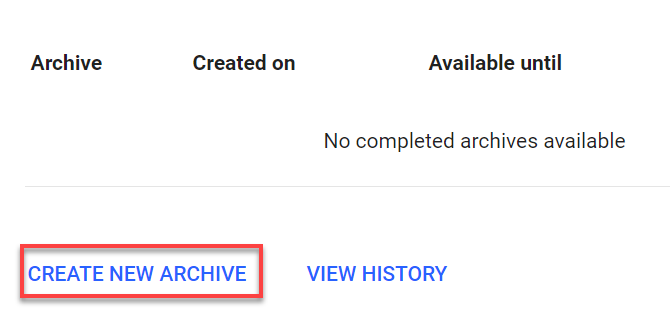
Click on Manage Archives link, and then click on Create New Archive.
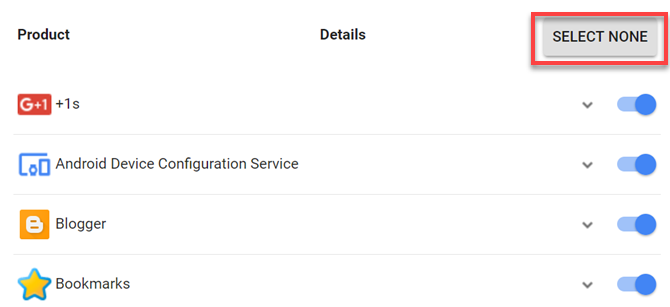
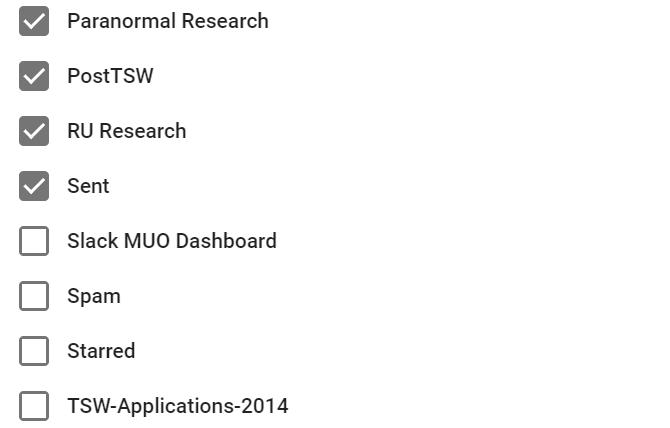
Scroll down to your list of accounts and click Select None to deselect all accounts.
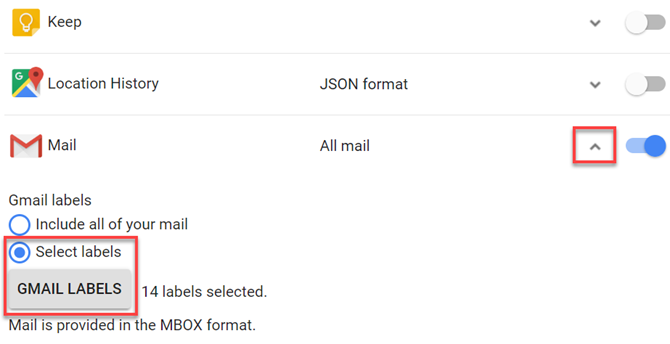
Then scroll down to your Gmail account, and click the switch to enable that service only.
Click the dropdown arrow, and click on Select labels.
Go down the list of labels you’ve created in your Gmail account, and select all of the ones you want to take a full backup of.
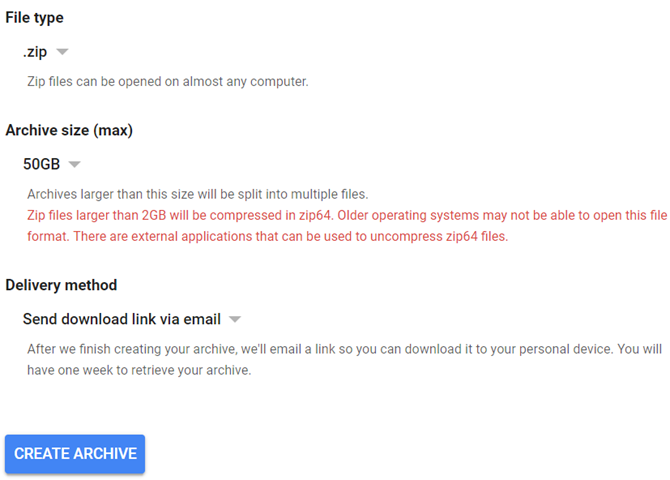
Under the list, you can select the compressed file format and the max archive size.
Finally, click the Create Archive button.
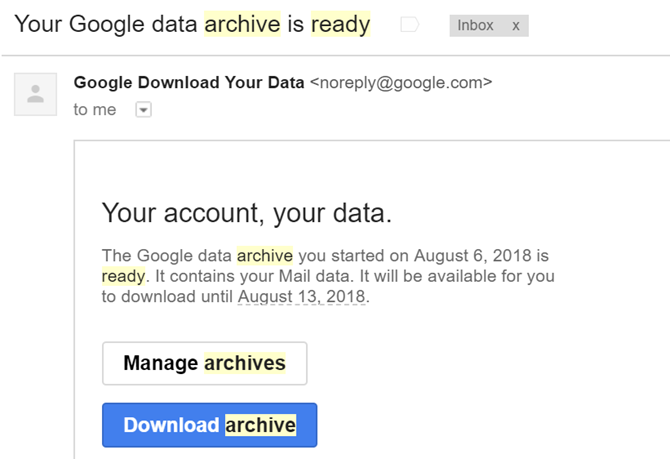
Google will email you that it’s started taking your archive. It could take a few hours or even a day, but eventually, you’ll receive a follow-up email when the archive is ready to download. The download link will be right in the email message.
Once you’ve downloaded and saved your email archive someplace safe, you’re ready to start wiping out labeled emails.
Delete Labeled Emails and Labels
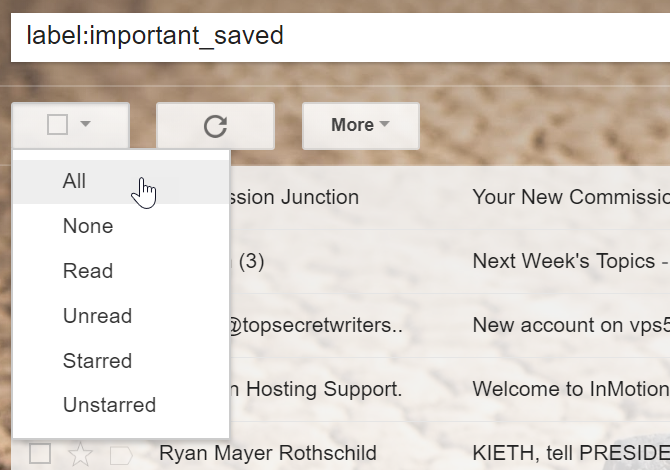
Back in your Gmail inbox, click on each label so the emails display, and select All from the select list.
Remember to select all conversations like you did before.
Click the trash icon to delete all of those emails.
If you’re lucky, you’ll come across labels with thousands of emails you can clean out of your inbox now that you have a backup.
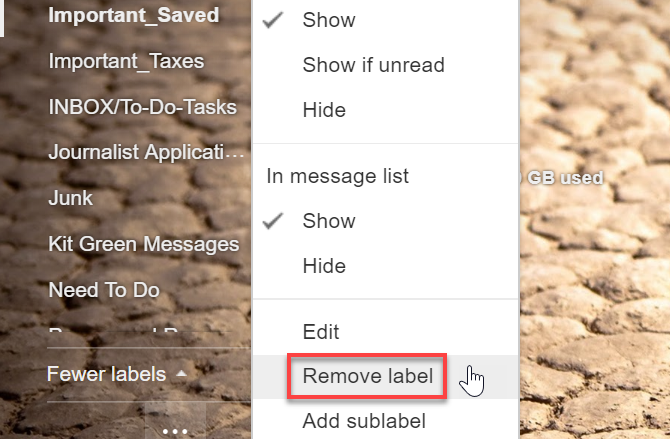
Once you’ve cleaned out all of the emails, don’t forget to delete all those old labels. Just click the dropdown on the right side of the label name and choose Remove label from the list.
At this point, you should have already chopped down the size of your inbox significantly. But let’s not hold back. We’ve got a few more tricks up our sleeves.
Delete Old Emails
If you have tens of thousands of emails, the odds are pretty good that even the emails that used to be important four or five years ago aren’t very important anymore.
Now’s the time to really dig deep and clean house. Let’s get rid of those very old emails.
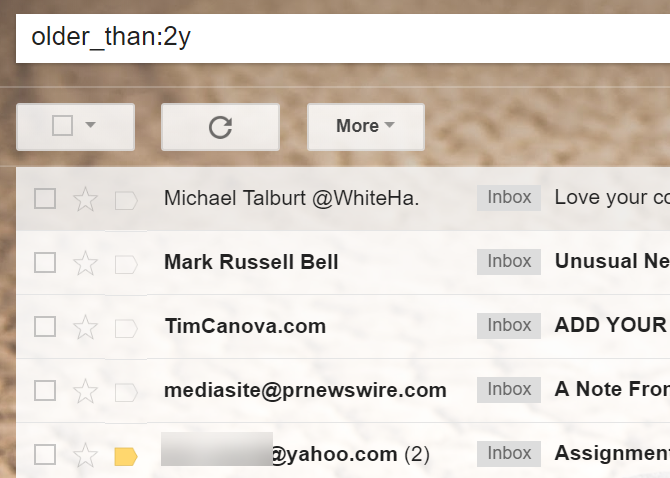
To do this, just type “older_than:2y” in the Gmail search field. You can set any time limit you want by changing 2 to whatever number of years of email you’d like to keep.
Just remember that whatever volume of emails you “keep”, you’re going to have to sort through at the end to pull out the truly important ones. So make this timeframe as small as you’re comfortable with.
Select All emails, and select all conversations, then click the Trash icon just like you’ve been doing all along.
After that, your email inbox of tens of thousands should be getting down into at last the single thousands by this point.
At this point, it’s time to take a slightly more selective approach to clean up the remaining mess.
Clean, Sort, and Organize
First, consider that any email you haven’t actually opened beyond a couple of weeks ago, you’re probably never going to open.
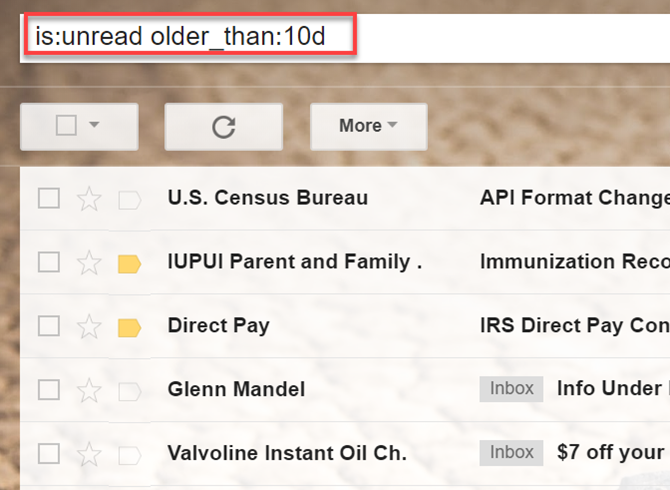
You can quickly clean those up by searching for all unread emails older than ten days.
In the search field, just type “is:unread older_than:10d”.
Select and delete all of those listed emails.
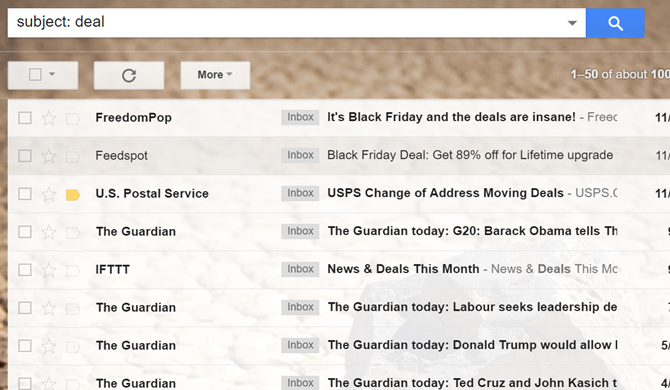
Another approach to trim down the remaining list of emails even further is to search for typical spam or promotional subject lines. You can do this by typing searches like “subject: deal”, “subject: giveaway” or “subject: last chance”.
Every search should turn up well over 100 emails at a time. Just keep wiping them out.
Finish Off Your Inbox
At this point, your mountain of tens of thousands of emails should be pared down to a much more manageable size. You’ve now concentrated your inbox to mostly email messages that are important to you and that you may want to keep.
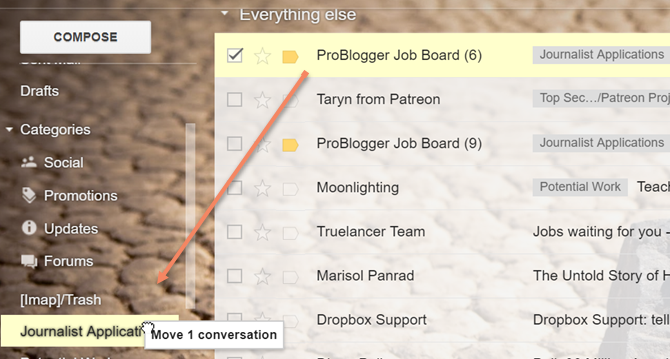
Next, start scrolling through the remaining emails. When you spot important emails you want to keep, just drag them over to the labels you’ve created for them (or create new labels if they don’t exist yet).
This sounds like a chore, but visually scanning a page of emails at a time should only turn up a few you actually want to keep. Then you can select all emails on that page and delete them all. This will wipe out 50 or so emails at a time.
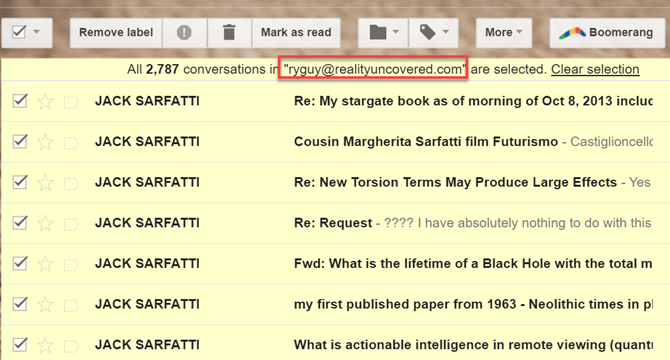
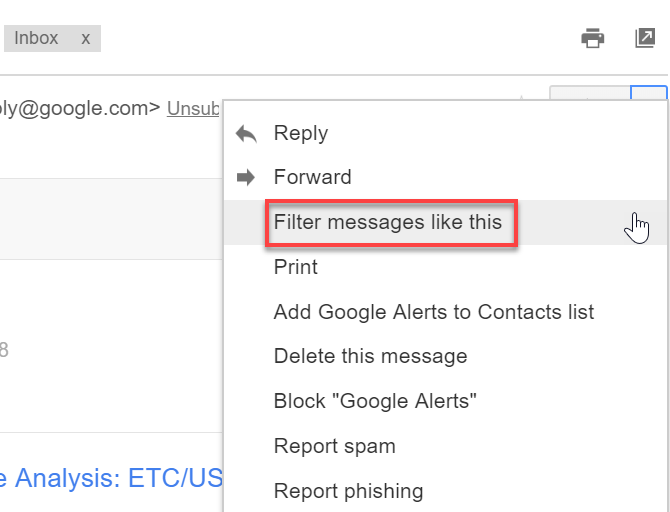
Remember, whenever you notice a repeat sender turning up, open the email and click the dropdown arrow next to the reply button. From this list click “Filter messages like this”.
Then select all and delete the list of matching emails that show up.
By labeling, filtering, and deleting big blocks of emails, you’ll have that list of just over 1,000 emails down to that miraculous inbox zero in no time.
It’s a tremendous feeling seeing that “empty” note in the inbox, especially when you’ve gone years without seeing it!
Don’t Let the Beast Grow
Now that you’ve taken the time to finally get that giant beast of an inbox under control again, it’s important to keep it from growing too big again. The best way to do that is to study all of the features Gmail has available to keep things organized and streamlined.
The Power User Guide to Gmail This free Gmail Guide is for those of you who already use Gmail as an email client and want to take maximum advantage of its many productivity features. Read More
, and never face having to go through this process again.
Work-Bench, a New York City venture capital firm that spends a lot of time around Fortune 1000 companies, has put together The Work-Bench Enterprise Almanac: 2018 Edition, which you could think of as a State of the Enterprise report. It’s somewhat like Mary Meeker’s Internet Trends report, but with a focus on the tools and technologies that will be having a major impact on the enterprise in the coming year.
Perhaps the biggest take-away from the report could be that the end of SaaS as we’ve known could be coming if modern tools make it easier for companies to build software themselves. More on this later.
While the report writers state that their findings are based at least partly on anecdotal evidence, it is clearly an educated set of observations and predictions related to the company’s work with enterprise startups and the large companies they tend to target.
As they wrote in their Medium post launching the report, “Our primary aim is to help founders see the forest from the trees. For Fortune 1000 executives and other players in the ecosystem, it will help cut through the noise and marketing hype to see what really matters.” Whether that’s the case will be in the eye of the reader, but it’s a comprehensive attempt to document the state of the enterprise as they see it, and there are not too many who have done that.
The big picture
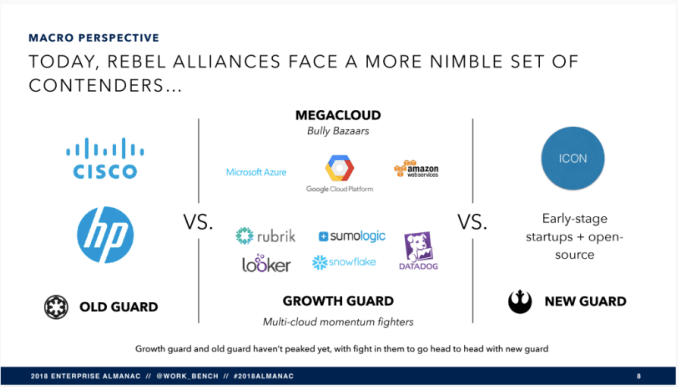
The report points out the broader landscape in which enterprise companies — startups and established players alike — are operating today. You have traditional tech companies like Cisco and HP, the mega cloud companies like Amazon, Microsoft and Google, the Growth Guard with companies like Snowflake, DataDog and Sumo Logic and the New Guard, those early stage enterprise companies gunning for the more established players.
As the report states, the mega cloud players are having a huge impact on the industry by providing the infrastructure services for startups to launch and grow without worrying about building their own data centers or scaling to meet increasing demand as a company develops.
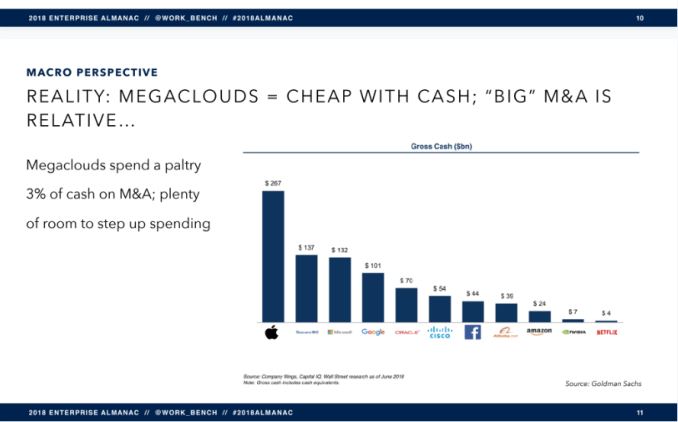
The mega clouders also scoop up a fair number of startups. Yet they don’t devote quite the level of revenue to M&A as you might think based on how acquisitive the likes of Salesforce, Microsoft and Oracle have tended to be over the years. In fact, in spite of all the action and multi-billion deals we’ve seen, Work-Bench sees room for even more.
It’s worth pointing out that Work-Bench predicts Salesforce itself could become a target for mega cloud M&A action. They are predicting that either Amazon or Microsoft could buy the CRM giant. We saw such speculation several years ago and it turned out that Salesforce was too rich for even these company’s blood. While they may have more cash to spend, the price has probably only gone up as Salesforce acquires more and more companies and its revenue has surpassed $10 billion.
About those mega trends
The report dives into 4 main areas of coverage, none of which are likely to surprise you if you read about the enterprise regularly in this or other publications:
Machine Learning
Cloud
Security
SaaS
While all of these are really interconnected as SaaS is part of the cloud and all need security and will be (if they aren’t already) taking advantage of machine learning. Work-Bench is not seeing it in such simple terms, of course, diving into each area in detail.
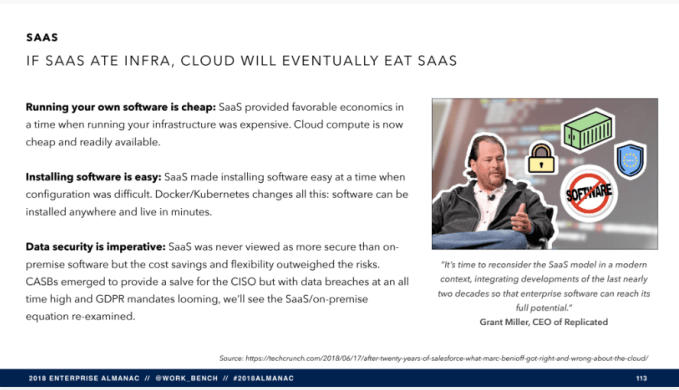
The biggest take-away is perhaps that infrastructure could end up devouring SaaS in the long run. Software as a Service grew out of couple of earlier trends, the first being the rise of the Web as a way to deliver software, then the rise of mobile to move it beyond the desktop. The cloud-mobile connection is well documented and allowed companies like Uber and Airbnb, as just a couple of examples, to flourish by providing scalable infrastructure and a computer in our pockets to access their services whenever we needed them. These companies could never have existed without the combination of cloud-based infrastructure and mobile devices.
End of SaaS dominance?
But today, Work-Bench is saying that we are seeing some other trends that could be tipping the scales back to infrastructure. That includes containers and microservices, serverless, Database as a Service and React for building front ends. Work-Bench argues that if every company is truly a software company, these tools could make it easier for companies to build these kind of services cheaply and easily, and possibly bypass the SaaS vendors.
What’s more, they suggest that if these companies are doing mass customization to these services, then it might make more sense to build instead of buy, at least on one level. In the past, we have seen what happens when companies try to take these kinds of massive software projects on themselves and it hardly ever ended well. They were usually bulky, difficult to update and put the companies behind the curve competitively. Whether simplifying the entire developer tool kit would change that remains to be seen.
They don’t necessarily see companies running wholesale away from SaaS just yet to do this, but they do wonder if developers could push this trend inside of organizations as more tools appear on the landscape to make it easier to build your own.
The remainder of the report goes in depth into each of these trends, and this article just has scratched the surface of the information you’ll find there. The entire report is embedded below.












 Protecting the data stored in your database may have been at the top of your priorities recently, especially with the changes that were introduced earlier this year with